Wood vs Steel Pizza Peel: Which Should You Choose? (November 2026)
Choose wood to build and launch raw dough, and steel to retrieve a baked pizza. In this wood vs steel pizza peel comparison, the best peel depends on which job you do most, since wood and steel handle dough and heat very differently.
On this page (12 sections)
- Wood vs steel pizza peel: the quick verdict
- The two materials side by side
- Launching raw dough: wood has the edge
- Retrieving baked pizza: steel has the edge
- Size and shape: match the peel to your pizza
- Weight and handling in a hot oven
- Surface grip and flour: how dough releases
- Turning and checking the crust
- Serving, slicing and storage after the bake
- Care, seasoning and daily use
- Who should buy wood, and who should buy steel?
- Wood vs steel pizza peel: the verdict
Choose wood to build and launch raw dough, and steel to retrieve a baked pizza. In this wood vs steel pizza peel comparison, the material matters less than the job you ask the peel to do at each stage.
Wood gives raw dough a wide, forgiving surface to build on. Steel gives a baked pizza a thin edge to slide under without disturbing toppings or crust.
We compared 4 products to show the split in real sizes and materials. Two are wood boards for launching and serving, one is an aluminum peel for retrieval, and one is a stone set with a perforated metal peel.

Wood vs steel pizza peel: the quick verdict
Wood wins for launching, steel wins for retrieving. If you must pick one peel, pick the material for the job you struggle with most.
Raw dough is sticky, flexible and easy to tear. A wood peel helps you stretch, sauce and top that dough before it ever meets heat.
A baked pizza is hot, rigid and easy to burn your hands on. A steel peel helps you turn, check and remove that pizza with a thin, flat edge.
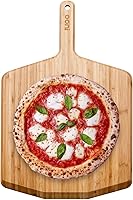
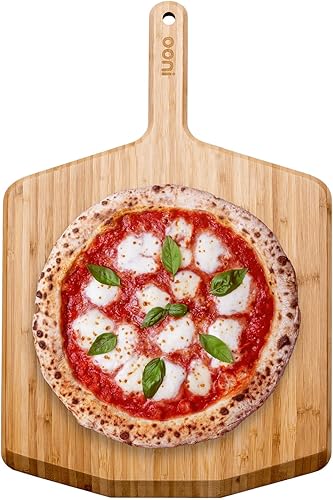
Our top wood pick is the Ooni 16” Bamboo Pizza Peel at 9.7. It is built for pizzas up to 16 inches and doubles as a serving board.
Our top steel pick is the Mooues Pizza Peel Aluminum 12 inch Pizza at 9.5. It is thin, light and made to slide under a baked base.
The two materials side by side
Wood and steel differ in edge thickness, surface grip and care. Those 3 traits decide how each peel launches and retrieves pizza.
Wood peels in this guide are bamboo or wood boards about 0.5 inch thick. That thickness gives a flat, stable surface for building dough, but it is harder to slide under a finished crust.
Steel and aluminum peels are thin sheet metal. That thin edge slides under a pizza with little lift, but raw dough can stick to the smooth surface.
| Trait | Wood peel | Steel or aluminum peel |
|---|---|---|
| Best job | Build and launch raw dough | Turn and retrieve baked pizza |
| Edge | Thicker, about 0.5 inch on wood boards here | Thin sheet metal edge |
| Surface | Bamboo or wood, needs flour for release | Smooth metal, needs flour or cornmeal |
| Serving use | Often doubles as a serving board | Usually not used for serving |
| Care | Hand wash, keep dry | Wipe or hand wash, remove protective film |
| Product | Best for | Size | Material | Weight | Our score |
|---|---|---|---|---|---|
| Ooni 16” Bamboo Pizza Peel | launching dough | 25.5 x 16.1 inch | Bamboo | 2 kg | 9.7 |
| Loftern Wooden Pizza Peel 16 Inch Board | serving and slicing | 25 x 16.14 inch | Wood | 1.6 pounds | 9.6 |
| Mooues Pizza Peel Aluminum 12 inch Pizza | retrieving pizza | 12 x 14 inch paddle | Aluminum | 1.6 pounds | 9.5 |
| Hans Grill Pizza Stone PRO XL | a stone and peel set | 14.9 x 11.8 inch stone | Cordierite | Stone and peel set | 9.3 |
For a wider look at metal options, our wood vs metal pizza peel guide breaks down the same trade offs in more detail.
Launching raw dough: wood has the edge
Wood is easier for launching raw dough because you can build the pizza right on the peel. You get space to stretch, sauce and top without moving a fragile base.
The Ooni 16” Bamboo Pizza Peel is designed for pizzas up to 16 inches wide. Ooni says to lightly flour the bamboo paddle before laying and prepping your pizza on it.
That flour step matters. It creates a barrier between sticky dough and the bamboo surface, so the pizza slides off in one confident move.
The Loftern Wooden Pizza Peel 16 Inch Board adds engraved circle markings for 10, 12, 14 and 16 inch pizzas. Those guides help you size the dough before you add toppings.
Steel can launch dough too, but you have less room for error. The Mooues aluminum paddle is 12 x 14 inch, so a large or round pizza can overhang the edges.
Retrieving baked pizza: steel has the edge
Steel is easier for retrieving because its thin edge slides under a hot crust. You can check the base, turn the pizza and lift it out with less pushing.
The Mooues paddle uses high quality aluminum and is described as thin enough that a little cornmeal helps the pizza slide off. That thin profile is the point of a metal peel.
The Hans Grill set includes a 12 inch perforated metal peel. Perforations let excess flour fall away before launching, and steam can escape from the underside after the bake.
Wood can retrieve pizza, but the thicker edge can lift one side and move toppings. For a soft or heavily topped pizza, that lift can tear the crust.
If you cook in an outdoor pizza oven, retrieval speed matters even more. A hot oven does not wait while you work a thick board under a pizza.
Size and shape: match the peel to your pizza
Pick a peel at least as wide as your largest pizza, with room for your hand to guide it. A peel that is too small forces dough to hang over the edge.
The Ooni board measures 25.5 x 16.1 inches overall, with a 16 inch paddle for pizzas up to 16 inches. That size suits large home pizzas and slim ovens.
The Loftern board measures 25 inches long including the handle and 16 inches wide. Its outer engraved circle is for 16 inch pizzas, with guides for smaller pies.
The Mooues paddle is 12 x 14 inch and extends to 12 x 25 inch with the handle extended. That 12 inch width suits standard pizzas but not the largest pies.
The Hans Grill stone measures 14.9 x 11.8 inches, and its peel is 12 inches. Size the pizza to the stone and peel, not the other way around.
Our best pizza peel for oven guide helps you match peel size to oven depth and door width.
Weight and handling in a hot oven
Lighter peels are easier to control when you reach into a hot oven. Weight matters most when the peel is long and fully extended.
The Ooni bamboo peel weighs 2 kg, which is heavier than the other peels here. That weight comes with a wide, stable board for building dough.
The Loftern board weighs 1.6 pounds and the Mooues peel also weighs 1.6 pounds. Both are easier to maneuver for a quick turn or retrieval.
The Mooues handle is wood and offers a comfortable grip while avoiding heat transfer. That matters when you hold the peel near a hot oven mouth.
A long peel gives reach, but it also acts as a lever. Keep your wrist level and move the pizza in one smooth push or pull.
If you cook on a pellet grill, our How To Cook A Pizza On A Wood Pellet Grill? guide covers peel use at grill temperature.
Surface grip and flour: how dough releases
Wood needs flour, steel needs flour, and both need it before the dough touches the surface. The difference is how much margin each gives you.
Bamboo and wood are more forgiving because the surface has natural texture. Even so, Ooni advises a light flour dusting before you lay dough on bamboo.
Aluminum is smooth and rust resistant, so dough can grip it fast. A light dusting of cornmeal or flour helps the pizza slide off the metal.
Perforations help in a different way. The Hans Grill peel has a perforated non stick surface that lets excess flour fall away before launching.
Do not add so much flour that it burns on the oven floor. A light, even dusting releases the dough without leaving a bitter layer.
For wood care and flour use, our best wood for pizza peel guide explains why bamboo and wood behave differently.
Turning and checking the crust
Steel gives finer control for turning a pizza during the bake. Its thin edge lets you lift one side without moving the whole pie.
With a wood peel, turning means lifting the full pizza on a thick board. That move can shift toppings and can tear a thin crust.
Our best pizza peel steel guide covers metal peels made for turning and retrieval. Those peels are usually thinner and narrower than launch boards.
Use the peel to check the underside, then turn the pizza 180 degrees for even browning. Work quickly and keep the pizza flat.
If you only own a wood board, you can still turn a pizza with it. Slide the board under the pizza in one move and avoid wiggling the edge.
Serving, slicing and storage after the bake
Wood peels double as serving boards, while steel peels are tools you put away after the bake. That second use is a real reason to choose wood.
The Ooni peel doubles as a board for serving and slicing pizzas. You can launch, bake, bring it back and serve on the same surface.
The Loftern board is reversible and works as a cheese board, charcuterie board or fruit board. Its engraved slice lines help you cut 6 even slices.
The Mooues peel folds for storage. You remove the screws, rotate the handle and fit the 12 x 14 inch paddle into the included storage bag.
The Hans Grill set is a stone plus peel, so storage needs more space. The stone is 15 x 12 inch and needs a flat, safe place to cool.
Care, seasoning and daily use
Hand wash both wood and steel peels, and keep wood dry between uses. Care is simple if you match it to the material.
The Ooni and Loftern wood boards both call for hand wash only. Do not soak wood peels, and dry them fully before you store them.
Loftern says to season its bamboo board before use to enhance flavor and results. Follow that guidance and reapply care as the surface dries out.
The Mooues peel arrives with a layer of blue film to prevent scratches. Remove that film before first use, or it will interfere with the surface.
The Hans Grill stone is hand wash only, and staining is normal for a pizza stone. Marks do not affect how the stone cooks, according to Hans Grill.
Who should buy wood, and who should buy steel?
Buy wood if you build on the peel, and buy steel if you build on a counter and retrieve at the oven. Your workflow decides the material.
Choose the Ooni 16” Bamboo Pizza Peel if you want a large launch board that also serves as a slicing board. It suits cooks who build the whole pizza on the paddle.
Choose the Loftern board if you want size guides and slice lines for serving. It suits cooks who value presentation as much as launching.
Choose the Mooues aluminum peel if you want a thin retrieval tool and a cutter in one set. It suits cooks who store gear in small spaces and fold the handle away.
Choose the Hans Grill set if you want a stone and a perforated peel together. It suits cooks who bake on a grill or in an oven and want one box.
Wood vs steel pizza peel: the verdict
Pick wood for launching and steel for retrieving, and buy both if you can. In a wood vs steel pizza peel choice, the job you do at the oven matters most.
If you buy one peel, choose wood when you build and launch on the peel, and choose steel when you only use the peel to turn and remove a baked pizza.
For most home cooks, a wood launch board plus a thin steel retrieval peel covers every stage. That pairing avoids the thick edge problem and the sticky dough problem in one setup.
Start with the Ooni for launching and serving, add the Mooues for retrieval, and size both to your largest pizza. Your next bake will move faster from counter to oven to table.
Frequently asked questions
Is a wood peel better than a steel peel for pizza?
A wood peel is better for building and launching raw dough because its wide, textured surface gives you room to stretch and top the base. A steel peel is better for retrieving a baked pizza because its thin edge slides under the crust with less disruption.
Many cooks use one peel for each job.
Can you launch raw dough on a steel pizza peel?
You can launch raw dough on steel, but you need a light dusting of flour or cornmeal so it slides off the smooth metal. Steel is thinner than wood, so dough can stick faster if the surface is damp or warm.
Wood gives more margin for error when you are learning to launch.
Which peel is easier to retrieve a baked pizza with?
Steel is easier for retrieval because the thin metal edge fits under a hot crust without lifting the whole pizza. Wood also works, but its thicker edge can push toppings or tear a soft crust.
For turning a pizza during the bake, a thin steel peel gives finer control.
Do I need both a wood and a steel pizza peel?
You do not need both, but many pizza setups use wood to launch and steel to turn and retrieve. If you only buy one, choose wood if you build on the peel, and choose steel if you build on a counter and only use the peel at the oven.
Size and storage also matter.