Grilling Tools and Cookware: The Complete Buying Guide
The right grill tools are the ones that fit your grill, your food and your hands: a long spatula and tongs for direct grilling, gloves for heat, a basket for small foods, and cast iron for searing and sides. Buy the core tools first, then add cookware that solves a specific job.
On this page (10 sections)
- What are the essential grill tools to buy first?
- How long should a grill spatula handle be?
- When should you use tongs instead of a spatula?
- Which grill gloves protect your hands best?
- How does a grill basket stop food from falling?
- What cast iron cookware works best on a grill?
- Which Dutch oven should you use for grilling and sides?
- How do grill pans and flat top tools fit in?
- What specialty grill tools should you add next?
- How do you choose, set up and care for grill tools?
The right grill tools are the ones that fit your grill, your food and your hands: a long spatula and tongs for direct grilling, gloves for heat, a basket for small foods, and cast iron for searing and sides.
Buy the core tools first, then add cookware that solves a specific job.
This guide covers grill tools as a complete system.
You will find spatulas, tongs, gloves, baskets, pans, rotisserie and racks in their proper place, so you can buy in order instead of buying twice. If you need a rotisserie for indoor cooking, see rotisserie kits for ovens.
Our score weighs specs, features and buyer feedback against what you're shopping for.
We compared product specs and looked at buyer patterns to build this guide.
We do not test products ourselves.
The system starts with heat control.
Food must be turned, moved and protected without losing texture.
Tools must reach the coals without burning knuckles.
Cookware must hold heat without making the grill hard to manage.
Size matters in every category.
A spatula head, a tong tip, a pan diameter and a Dutch oven volume all change what you can cook in one batch.
Weight matters too.
Cast iron at 5.4 to 14.9 pounds sits in a different class from a thin steel pan.
That weight shapes how you lift, pour and store the piece.
Care matters from the first wash.
Hand washing, drying and oiling keep cast iron ready.
Gentle washing keeps enamel intact.
What are the essential grill tools to buy first?
The essential grill tools are a long spatula, tongs, heat-resistant gloves and a grate brush if your grill needs one. Those tools cover turning, moving, protecting your hands and cleaning the grates.
Start with two turning tools. A wide spatula slides under burgers and fish, while tongs grip steaks, sausages and smaller pieces.
One solid pair of each will do more work than a large set you rarely reach for. A spatula also sets the pace of a cook.
It lets you check the underside of a burger without breaking it. It lets you test whether a fillet releases from the grates.
Tongs set a different pace. They let you roll a sausage, nudge a chicken piece and move food to a cooler zone.
Gloves matter because grilling puts your hands close to heat. You need them for moving grates, lifting a hot pan, shifting coals and handling food near flare-ups, plus steam from a lid lift, a basket flip or a pan pour.
Our guide to Best Grill Gloves covers materials, cuff length and grip. A grate brush matters when residue builds up, since a clean grate browns food evenly and helps release it.
A case or holder keeps the first tools together. If you want a full set in one place, start with our best grill tool set case picks and then add specialty tools as your meals demand them.
Storage shapes use. Tools in a case stay clean and ready, while tools in a drawer get bent and mixed with kitchen tools.
Buy length for the grill you own. Measure from the front edge to the coals and from your standing position to the food, as that distance sets the handle that keeps you safe.
How long should a grill spatula handle be?
A grill spatula handle should keep your hand away from the heat while still giving you control. For most home grills, a long handle around 16 to 18 inches gives that balance.
A short kitchen spatula forces your hand over the flames. That makes flipping feel risky and slows you down.
Our picks for the best long handle grill spatula show common lengths and head shapes. A wider head supports a burger or fish fillet, while a narrower head fits between bars and around crowded food.
Head shape changes pressure. A wide head spreads weight across the food, and a narrow head concentrates pressure at one point and can tear soft food.
If your grill is deep or you cook over a large charcoal bed, consider the best extra long grill spatula options. Extra length adds reach, but it also adds leverage, so a heavy load can feel harder to control.
Leverage shows up most with wet food. A fillet or thick burger pulls the tip down, and a longer handle magnifies that pull at the hand.
Look at the head first, then the handle. A thin, flexible head slides under food with less tearing, while a rigid head can push food off the grates if you angle it wrong.
Flex also helps on cast iron. A thin edge can slide under eggs, fish and cornbread without scraping the seasoning.
Check the grip and joint as well. A textured or insulated grip helps you keep control, and a sealed grip with no seams wipes clean.
A solid weld or rivet resists bending when you lift a heavy load. A weak joint flexes and makes placement imprecise.
When should you use tongs instead of a spatula?
Use tongs when you need grip, and use a spatula when you need support. Tongs turn steaks, sausages, chicken pieces and vegetables.
A spatula lifts burgers, fish and anything that would break under pressure. Many cooks buy a best grill spatula with tongs combination because the two tools work as a pair.
The spatula supports from below, and the tongs steady the top edge. That pair is useful for delicate fillets and thick burgers.
The pair also helps with food that has loose topping. Cheese, sauce and seasoning stay on the food when both sides are controlled.
Tongs also let you move food to a cooler spot on the grill. That matters when one side runs hotter than the other, so you can shift a piece to finish without burning it and sear over direct heat before resting over indirect heat.
Choose tongs with a firm spring and a tip that meets fully. Loose tongs drop sausage and make you chase food across the grates.
Tip shape matters for small food. Flat tips grip a steak without piercing it, while pointed tips pick up a shrimp or a pepper strip with more precision.
A locking loop helps with storage. It should hold the tips closed in a case and release with one hand when you need to work fast, so test the lock before you buy.
Match tong length to the spatula. Two tools of similar reach let you work with both hands at the same height, while a very short pair beside a very long spatula forces an awkward stance.
Heat also affects tong choice. Metal tongs conduct heat along the arms, while insulated grips reduce that transfer and silicone tips add grip.
Which grill gloves protect your hands best?
The best grill gloves protect your hands without stopping you from feeling what you are holding.
Look for heat resistance, a cuff that covers your wrist and a grip that works with wet tongs.
Leather, aramid and silicone-coated gloves each handle heat differently.
Leather gives a natural grip and resists sparks.
Aramid resists high heat well.
Silicone-coated options grip metal and silicone tools with more control.
Material also affects breathability.
A lined glove feels softer for long cooks.
An unlined glove gives more feel for tongs and small tools.
Cuff length matters for coal and grate work.
A longer cuff protects your forearm when you reach deep into a grill.
A shorter cuff gives more wrist freedom for turning food.
Cuff shape matters as well.
A gauntlet style covers more arm.
An elastic cuff stays in place when you reach.
Our Best Grill Gloves guide breaks down which glove suits turning, coal handling and moving hot cookware.
Glove size changes control.
A glove that is too large bunches at the fingers.
A glove that is too small limits blood flow during a long cook.
Try gloves with the tools you use most.
Hold a spatula, tongs and a pan handle while wearing them.
Pair gloves with a handle holder for cast iron, since the handle stays hot long after cooking ends.
A holder also lets you move a pan from grill to table with one hand.
Do not use kitchen oven mitts as a default.
Many are thick, damp inside and hard to grip with.
Grill gloves are shaped for outdoor work and for holding tools, not just lifting a tray.
Mitts also make it hard to feel a tong spring.
That loss of feel leads to dropped food.
Replace gloves when the palm thins, the seams open or the lining wears through.
Heat protection drops fast once the material is damaged.
Store gloves dry and away from direct heat.
A damp glove loses insulation and can steam your hand.
How does a grill basket stop food from falling?
A grill basket keeps small and soft food together while heat reaches all sides. It is the simplest fix for vegetables, shrimp, fish, mushrooms and sliced potatoes that fall through grates.
The Best Grill Basket guide covers mesh size, handle length and locking designs. A fine mesh holds smaller pieces, while a wider mesh lets more smoke reach the food.
Mesh size is the key choice. Fine mesh suits peas, corn kernels and small shrimp.
Wider mesh suits zucchini, peppers and potato slices.
Stainless steel baskets handle heat well and clean with a brush and soapy water. Steel also resists warping when you flip a full basket.
Our best grill basket stainless steel picks show options for different grill sizes. Size the basket to your grate area, since a basket that fills the whole grill leaves no room for burgers or indirect cooking.
A smaller basket can sit beside other food and still turn easily. A basket must clear the grill lid and the side walls, so measure the cooking area before you buy.
Locking handles help when you need to flip the whole basket. That motion cooks both sides without skewers, and you do not need to chase each piece with tongs.
Check that the latch closes fully before the basket goes over heat. A loose latch opens under weight, and that risk grows with wet vegetables or seafood.
Preheat the basket before the food goes in. Food sticks less on a hot surface, and it starts browning instead of steaming.
Oil the basket lightly if you use foods that tend to stick.
Handle length should match your spatula and tongs. A short basket handle puts your hand over the coals, while a long handle keeps you back but makes a heavy basket harder to flip.
Fill the basket no more than half full for an even flip.
What cast iron cookware works best on a grill?
Cast iron cookware works best on a grill when you need steady heat, strong searing and a pan that can move from burner to grill to oven.
Skillets sear and fry, while Dutch ovens simmer, braise and bake.
Cast iron holds heat longer than thin steel.
That trait helps when cold food hits the surface.
The pan recovers heat instead of dropping in temperature.
Even heat also reduces hot spots.
Food browns more evenly across the bottom.
The Lodge Pre-Seasoned Cast Iron Skillet with Silicone Handle Holder is 12 inches, weighs 7.5 pounds and holds 1.89 liters.
Lodge says it is pre-seasoned with natural vegetable oil and made without PFOA or PTFE.
The silicone holder protects your hand when you move the hot pan.
That size suits a grill side burner, a campfire and a home stovetop.
It has room for several pieces of food without crowding.
The extra weight helps the pan keep heat when cold food goes in.
The pan is listed as oven safe and hand wash only.
Its maximum temperature is listed at 260 degrees C in the specs.
It is compatible with smooth surface induction.
Lodge describes it for searing, sautéing, baking, frying and campfire meals.
The teardrop handle is described for easy lifting and control.
The red silicone color makes the holder easy to spot on a grill side table.
The Lodge Pre-Seasoned Cast Iron Skillet with Hot Handle Holder is 10.25 inches and weighs 5.4 pounds.
Lodge says it includes a red silicone hot handle holder and an assist handle.
It is seasoned with 100 percent vegetable oil with no synthetic coatings.
The smaller pan is easier to lift and turn.
It fits a small side burner and a compact grill.
It also heats faster for a simple sear or a few eggs at camp.
Its maximum temperature is listed at 550 degrees Fahrenheit.
Its listed capacity is 190 ml, which reflects the shallow skillet form.
The assist handle helps with a two hand lift when the pan is full.
Lodge says the seasoning improves with use.
That means each cook adds a thin layer that builds release over time.
Which skillet size fits your grill?
The 12 inch skillet fits larger loads.
It holds several steaks, a full batch of vegetables or a frittata that needs oven time.
Its 7.5 pound weight gives stability on a grill grate.
The 10.25 inch skillet fits smaller loads.
It suits two steaks, eggs, cornbread or a small side dish.
Its 5.4 pound weight is easier to lift from a grill to a table.
Both skillets are pre-seasoned with natural vegetable oil.
Both include a silicone hot handle holder.
Both are described for oven, stove, grill and campfire use.
Choose by burner size first.
A pan that overhangs a small burner heats unevenly.
A pan that matches the burner heats more evenly.
Choose by storage next.
Cast iron needs a flat, dry spot.
A larger pan needs more shelf width.
The best cast iron skillet guide compares sizes from small to large.
The best lodge cast iron skillet accessories guide covers holders, scrapers and care tools that keep cast iron working well.
Which Dutch oven should you use for grilling and sides?
A Dutch oven handles foods that a skillet cannot, such as beans, soups, braises and slow-cooked sides.
The lid traps moisture and lets you simmer on a grill burner or stovetop.
A lid also protects food from wind and ash on an outdoor grill.
That protection matters on a charcoal grill with an open side burner.
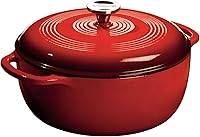
The Lodge Essential Enamel Cast Iron Dutch Oven and the Amazon Basics Enameled Cast Iron Dutch Oven both hold 6 quart.
That volume suits a family meal.
It also suits meal prep for leftovers.
The Lodge Essential Enamel Cast Iron Dutch Oven is 6 quart, round and weighs 14.9 pounds.
It has dual handles, a cast iron lid and an enamel coating.
Lodge says it is oven safe to 500 degrees Fahrenheit and PFAS free.
The enamel surface does not need seasoning.
It stands up to acidic foods and cleans with warm soapy water and a nylon brush.
Lodge says hand washing is recommended to keep the finish in good shape.
The pot is listed in oyster white.
Its dimensions are listed at 13.5 x 13.5 x 10.9 inches.
Its part number is EC6D13.
The enamel finish resists rust in a way bare cast iron does not.
That trait helps with marinades and tomato based sauces.
The Amazon Basics Enameled Cast Iron Dutch Oven is 6 quart, round and weighs 13.1 pounds.
It has dual handles and a cast iron lid.
The maker says it is oven safe to 500 degrees Fahrenheit and sized to serve 4 to 6 people.
Both pots hold the same volume, so choose by finish, color and care preference.
The Lodge pot is oyster white.
The Amazon Basics pot is blue and a little lighter.
The Amazon Basics pot is listed at 5.7 liters.
Its dimensions are listed at 13.8 x 11.06 x 4.7 inches.
The maker says to hand wash with warm soapy water and avoid citrus based cleaners and metal utensils.
That advice protects the enamel surface from chips and stains.
Our best cast iron dutch oven guide compares more sizes and shapes.
A round 6 quart pot fits most burners and grills.
A round shape also lets you stir without sharp corners.
A wider, shallower pot fits a whole chicken or a large roast with more ease.
Depth matters for simmering.
A deeper pot holds liquid without boil over.
A shallower pot gives more surface for browning.
Dual handles matter for a full pot.
A 6 quart pot full of soup is heavy.
Two handles spread the load across both hands.
How do grill pans and flat top tools fit in?
Grill pans and flat top tools fill the jobs between open grates and cast iron.
A pan holds small food, a flat top gives you a full cooking surface, and a skillet gives you deep searing power.
Stainless steel grill pans drain fat while they hold food above the grates.
Our best stainless steel grill pans best picks cover sizes for vegetables, seafood and small pieces.
A perforated pan drains more fat than a solid pan.
A solid pan holds juices for foods that need them.
A carbon steel skillet is another option for high heat.
Our best carbon steel skillet guide explains how it differs from cast iron in weight, seasoning and care.
Carbon steel is lighter than cast iron.
That weight saving helps when you lift a full pan.
It also heats faster on a burner.
Flat top accessories turn a griddle into a full breakfast station.
Our best flat top griddle accessories guide covers spatulas, scrapers, covers and drip trays.
A wide spatula moves eggs and pancakes.
A scraper cleans the surface after each batch.
A cover holds heat for melting cheese.
Charcoal grills need their own accessory set.
Our best charcoal grill accessories guide covers baskets, chimney starters, ash tools and heat deflectors.
A chimney starter lights coals evenly.
An ash tool clears ash for airflow.
A heat deflector creates zones for indirect cooking.
Choose one surface at a time.
A pan for small food, a skillet for searing and a Dutch oven for simmering will cover most meals.
Extra surfaces add storage and cleaning without adding new meals.
Each surface also needs its own tools.
A flat top needs a wide spatula.
A grill pan needs tongs.
A skillet needs a holder.
What specialty grill tools should you add next?
Specialty grill tools help with rotisserie, ribs and whole birds.
They are worth buying when you cook those foods often, not before you master the basics.
A rotisserie kit turns a charcoal grill into a self-basting oven.
Our best rotisserie kit for charcoal grill guide covers motor strength, spit length and counterbalance.
Motor strength matters for a large bird.
A weak motor slows the spit under weight.
Counterbalance keeps the rotation smooth.
For chicken, a dedicated roaster can give more even heat than a standard grill setup.
Our best chicken roaster machine guide compares capacity, heat control and cleanup.
A roaster holds shape and drippings.
That shape helps skin brown evenly.
Rib racks hold ribs upright so more surface browns.
Our best rib rack for grilling guide covers spacing, coatings and grill fit.
Spacing sets how much bark forms on each side.
Coating affects cleanup.
Grill fit sets how many racks you can cook at once.
Add one specialty tool based on the meal you cook most.
If ribs are a monthly habit, a rack pays off fast.
If whole chicken is rare, skip the rotisserie until your menu changes.
Specialty tools also need storage.
A rotisserie spit is long and needs a safe spot.
A rib rack needs width.
Store specialty tools with the core tools, not in a separate box.
A complete station makes you more likely to use the tool you bought.
A complete station also keeps parts together.
A rotisserie without its counterweight is hard to use.
How do you choose, set up and care for grill tools?
Choose grill tools by grill size, food type and storage space. Then set up a station that puts the tools you use first within reach.
Measure your grill first. Note the grate width, the distance from the front edge to the coals and the side burner size if you have one.
Those numbers set handle length and pan size. Buy in this order: spatula, tongs, gloves, brush, holder and case.
Add a basket for small foods. Add cast iron for searing and sides, and add rotisserie or racks only for foods you cook often.
Set up the station before you light the grill. Place the spatula and tongs on a clean tray, gloves where your non-dominant hand can reach them, and a dry towel or holder for hot cast iron.
Place a timer within reach as well. A calm station reduces trips to the kitchen, which can let food burn.
Wash metal tools with warm soapy water and dry them well. Store them in a case or on a rack where air can reach them, since damp storage invites rust on steel.
For cast iron skillets, hand wash, dry on the stove and rub in a thin layer of oil. Lodge gives that same care advice for its pre-seasoned skillets, and that oil layer protects the seasoning and helps release.
For enamel Dutch ovens, hand wash with warm soapy water and a nylon brush, and avoid metal utensils that can chip the finish. Store enamel pots with the lid ajar if you stack them to prevent moisture buildup.
Pick one core set that fits your grill, then add the basket, skillet or Dutch oven that matches your next meal. Start with the spatula and tongs from our best long handle grill spatula picks, add gloves, and build your grill tools station from there.
Add the 12 inch Lodge skillet for large sears and the 10.25 inch Lodge skillet for small loads. Add a 6 quart enamel Dutch oven for simmering and sides, since each piece has a clear job.
Frequently asked questions
What grill tools do I need first?
Start with a long spatula, tongs, a stiff brush if you use grates, and heat-resistant gloves. Those four cover most direct grilling jobs.
Add a basket for small foods and cast iron for searing after you know your cooking style.
Are long grill tools safer than short ones?
Longer handles keep your hands farther from heat and flare-ups. A 16 to 18 inch handle is a common workable length for many grills.
Extra long handles help on deep grills but can feel less precise, so match length to your grill size.
Can cast iron go on a grill?
Yes, cast iron skillets and Dutch ovens can be used on a grill, on a stovetop and in an oven when the model allows it. The Lodge skillets and Dutch ovens in this guide are described for grill and campfire use.
Check heat limits and handle protection before you cook.
Do I need a grill basket?
A grill basket helps when food is small, soft or likely to fall through grates. It is useful for vegetables, fish, shrimp and sliced potatoes.
If you mainly grill large steaks and burgers, you can add one later.
How should I clean grill tools?
Wash metal tools with warm soapy water, dry them well and store them dry. Hand wash cast iron, dry it on the stove and rub in a thin layer of oil.
Hand wash enameled cast iron with warm soapy water and a nylon brush.