
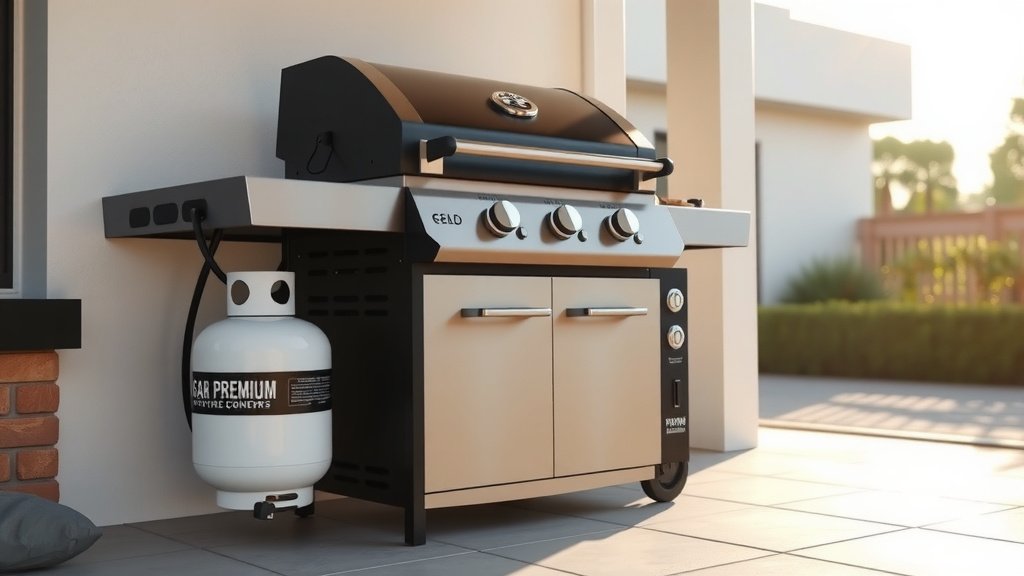
A standard 20-pound gas grill propane tank typically lasts between 10 to 25 hours of cooking time, depending on factors like your grill’s BTU output and how many burners you use.
For an average gas grill running at medium heat, you can often get around 15-20 grilling sessions, each lasting about an hour, from one full tank.
- A 20-pound propane tank lasts 10-25 hours of grilling.
- Many factors influence this, including your grill’s BTU rating and how many burners you light.
- High heat and multiple burners use fuel faster than lower heat and fewer burners.
- You can estimate your tank life by doing some simple math with your grill’s BTU.
- Keeping a spare tank on hand is the best way to avoid running out mid-cook.
How Long Does A Gas Grill Propane Tank Last?
Your gas grill propane tank’s life really depends on a few key things. Generally, you can expect a 20-pound tank to give you many hours of delicious grilling.
Think of it like your car’s gas mileage. A smaller engine on cruise control goes further than a big engine flooring it. Your grill works similarly.
Factors Affecting Your Propane Tank’s Life
Several elements play a big part in how long your gas grill propane tank lasts. Knowing these helps you plan your grilling sessions better.
Your Grill’s BTU Output
BTU stands for British Thermal Unit. It measures how much heat your grill can produce. A higher BTU grill means it burns more propane to generate that heat.
A smaller grill, say 30,000 BTUs, will use less fuel than a large, powerful 60,000 BTU grill over the same cooking time. Many experts say this is the primary factor to consider.
How Many Burners You Use
Are you using one burner for a few steaks, or all four for a big family cookout? Each lit burner consumes propane. More burners equal quicker fuel depletion.
You can make your tank last longer by only firing up the burners you absolutely need for your food.
Your Grilling Frequency and Heat Settings
Grilling every night? Or just on weekends? How often you grill, plus the heat setting, matters. Cooking on high heat uses more propane than medium or low settings.
A short sear at high heat then finishing on low can be more fuel-efficient than an hour-long, full-blast session.
The Size of Your Propane Tank
Most gas grills use a standard 20-pound propane tank. This size is convenient for portability and refilling. Larger tanks exist but are less common for home grills.
The bigger the tank, the more propane it holds, meaning it will naturally last for more grilling time. This sounds obvious, but it is worth noting.
Estimating Your Grill’s Propane Use
Want a more precise idea? You can do some simple math. Most 20-pound propane tanks hold about 4.7 gallons of liquid propane.
We found that one gallon of propane contains about 91,500 BTUs. So, a full 20-pound tank holds approximately 429,900 BTUs (4.7 gallons x 91,500 BTUs/gallon).
The BTU Math for Your Grill
Look at your grill’s total BTU output in its manual. If your grill is 40,000 BTUs, divide the tank’s total BTUs by your grill’s BTU rating (429,900 / 40,000).
This calculation suggests your tank would last about 10.7 hours running all burners on high. Remember, this is a maximum and you rarely use all burners on high continuously.
Typical Grill Scenarios
Here’s a general guide for how long a 20-pound tank might last on common grills, assuming medium heat usage:
| Grill Size/BTU Output | Approximate Hours Per 20lb Tank | Typical Number of 1-Hour Grilling Sessions |
|---|---|---|
| Small (25,000 – 30,000 BTUs) | 14 – 17 hours | 14 – 17 sessions |
| Medium (35,000 – 45,000 BTUs) | 10 – 13 hours | 10 – 13 sessions |
| Large (50,000 – 60,000 BTUs) | 7 – 9 hours | 7 – 9 sessions |
Signs Your Propane Tank is Low
Nobody wants to run out of gas mid-flip! Knowing these warning signs can save your meal and your sanity. Many grill masters keep a spare tank ready to go.
The Flames Look Weak
Are your grill flames looking a little lazy? If they are smaller than usual, flickering, or a dull orange instead of a vibrant blue, you might be low on propane.
This is often the first visual clue that your tank is nearing empty, and it’s time to think about a refill.
The Simple Weight Test
The easiest way to check is to simply lift the tank. A full 20-pound tank weighs about 37-38 pounds (20 lbs of propane + 17-18 lbs for the empty tank).
If it feels light as a feather, you probably have very little fuel left. This is a quick and effective check.
The Warm Water Test
Pour warm (not hot!) water down the side of the tank. After a minute or two, feel the tank with your hand.
The liquid propane inside absorbs heat, making the empty section feel warmer than the section with liquid propane. The “cold spot” indicates the fuel level.
Maximizing Your Tank’s Lifespan
Want to get the most out of every tank? A few smart habits can stretch your propane further. We found these tips to be quite effective.
Preheat Wisely
Your grill needs to preheat, but don’t overdo it. Once it hits the desired temperature, you’re good to go. Preheating for too long just wastes precious fuel.
Many experts suggest 10-15 minutes is usually sufficient for most grilling tasks.
Cook Efficiently
Plan your grill space and cook food in batches if necessary. Keep the lid closed as much as possible to retain heat. Every time you lift the lid, heat escapes, and your burners work harder.
This conserves heat and, by extension, your propane. It’s a simple yet impactful habit.
Maintenance Checklist
Regular maintenance can also contribute to efficiency:
- Clean your grill grates: Blocked grates can reduce heat transfer.
- Check for leaks: Use a soapy water solution on connections; bubbles mean a leak.
- Clean burner ports: Clear any debris to ensure even flame.
- Inspect gas lines: Look for cracks or damage to hoses.
- Store tank properly: Keep it upright and out of direct sunlight when not in use.
Running Out Mid-Cook? What to Do
It happens to the best of us! If your grill suddenly goes silent, don’t panic. If you have a spare tank, simply switch it out.
No spare? You can finish cooking in your oven or on your stovetop. Or, if the food is almost done, turn off the grill and let residual heat finish it. It’s not ideal, but it works!
Safety First: Handling Propane Tanks
Propane is safe when handled correctly. Always store tanks upright and outdoors, away from direct sunlight or heat sources. Never store them indoors or in enclosed spaces like garages.
When transporting, keep the tank upright and secure in your vehicle. Proper handling helps prevent accidents and ensures safety for everyone (DOT guidelines).
Conclusion
Understanding how long a gas grill propane tank lasts means you can grill with confidence, knowing you have enough fuel. The biggest factors are your grill’s BTU output, how many burners you use, and your heat settings. By being mindful of these, using simple checks, and following some basic efficiency tips, you’ll rarely run out of propane unexpectedly.
Having a spare, full 20-pound tank is the ultimate peace of mind for any grilling enthusiast. Happy grilling, and enjoy those perfectly cooked meals!
How do I know if my propane tank is almost empty?
The easiest ways are to lift the tank and feel its weight, or to perform the warm water test. You pour warm water down the side, and the part with liquid propane will feel cooler than the empty section.
Can a propane tank run out suddenly without warning?
While often there are warning signs like weaker flames, a tank can seem to run out suddenly, especially if you haven’t checked it in a while. This is why checking before you start grilling is a good habit.
Does cold weather affect how long a propane tank lasts?
Cold weather can affect propane tank performance. Propane vaporizes slower in colder temperatures, which can reduce the pressure available to your grill. It won’t necessarily make the tank “last longer” in terms of total fuel, but it might seem to perform less efficiently.
Is it better to refill or exchange a propane tank?
Many people find exchanging tanks more convenient as it’s quicker. However, refilling stations typically fill your tank completely and can sometimes be more cost-effective since you only pay for the propane, not the tank itself. Some research suggests refilling offers more propane per dollar.
Can I use a larger propane tank with my gas grill?
While you theoretically could, it’s not common or recommended for portability. Standard gas grills are designed for 20-pound tanks. Larger tanks are heavy, cumbersome, and can pose storage challenges for home use.
