
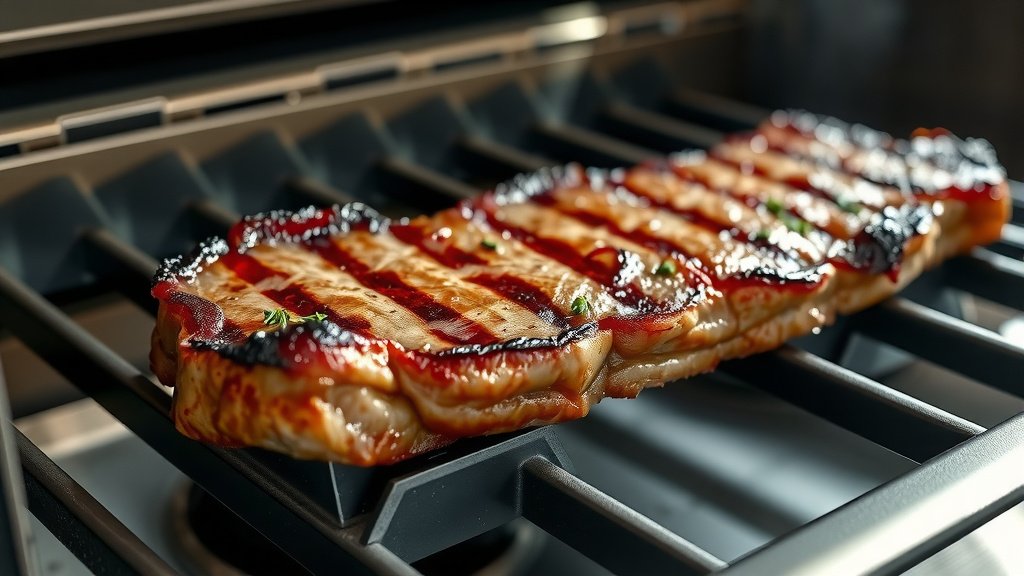
To grill T-bone steaks on a gas grill, preheat your grill to high for direct searing and medium-low for indirect cooking. Sear the steak on high heat for 2-3 minutes per side, then move it to the indirect zone to finish cooking until it reaches your desired internal temperature, typically 130-135°F for medium-rare.
Always use a meat thermometer to ensure accuracy when grilling T-bone steaks on a gas grill, and allow the steak to rest for 5-10 minutes off the heat before slicing to keep it juicy.
Here’s a quick rundown of how to grill a perfect T-bone:
- Choose a good quality, thick T-bone steak.
- Bring your steak to room temperature before grilling.
- Season simply with salt and pepper for the best flavor.
- Set up your gas grill for two-zone cooking: one hot, one cooler.
- Sear the steak over direct high heat, then finish over indirect heat.
- Use a meat thermometer to hit your desired doneness.
- Always rest your T-bone steak before slicing and serving.
How To Grill T Bones On A Gas Grill?
Grilling T-bone steaks on a gas grill involves a simple yet effective two-zone cooking method. You’ll sear it over high heat first, then let it finish gently over lower, indirect heat for perfect doneness.
Picking the Right T-Bone Steak
The journey to a great grilled T-bone starts at the butcher shop. Look for a steak that’s at least 1 to 1.5 inches thick. This thickness allows for that beautiful crusty sear without overcooking the inside.
Many experts say to choose steaks with good marbling, which means small streaks of fat within the muscle. This fat melts during cooking, adding incredible flavor and juiciness (USDA Quality Grades).
Prepping Your T-Bone for Grilling
Before any heat touches your steak, a little prep goes a long way. First, take your T-bone out of the fridge about 30-60 minutes before you plan to grill. Letting it come closer to room temperature helps it cook more evenly.
Next, pat your steak thoroughly dry with paper towels. We found that a dry surface is key for achieving a really good sear. Moisture on the surface can steam the meat instead of browning it.
Seasoning Your Steak for Flavor
For a cut as flavorful as a T-bone, often less is more when it comes to seasoning. Many grill masters will tell you that a generous amount of coarse salt and freshly ground black pepper is all you truly need.
You can also add a touch of garlic powder or your favorite beef rub. Just ensure the seasoning adheres well to the dry surface.
Setting Up Your Gas Grill for Success
To properly grill a T-bone, you’ll want to create two heat zones on your gas grill. This technique is often referred to as “two-zone grilling,” and it’s a game-changer for thicker cuts of meat.
Turn one or two burners to high heat for your direct searing zone. On the other side, set one burner to medium-low, or turn it off entirely, creating your indirect cooking zone.
Why Two Zones Matter for T-Bones
The direct high heat zone is where you’ll get that fantastic crispy crust, known as the Maillard reaction. After searing, the indirect zone allows the steak to cook through to your desired doneness without burning the outside.
We found this method prevents a tough, overcooked exterior and an undercooked interior. It’s like having a hot oven and a gentle oven side-by-side.
Grilling Your T-Bone: The Searing Phase
Once your grill is preheated and screaming hot, place your T-bone directly over the high-heat burners. You should hear that satisfying sizzle right away.
Sear the steak for about 2-3 minutes per side. You’re looking for a rich, dark brown crust. Resist the urge to move it around too much during this stage; let that crust form undisturbed.
Achieving Perfect Doneness: Indirect Cooking
After searing both sides, move your T-bone over to the indirect heat zone. Close the grill lid to allow the heat to circulate around the steak, cooking it gently and evenly.
This is where your meat thermometer becomes your best friend. Insert it into the thickest part of the steak, avoiding the bone, to monitor the internal temperature.
| Doneness | Internal Temperature | Look and Feel |
|---|---|---|
| Rare | 125-130°F (52-54°C) | Cool red center |
| Medium-Rare | 130-135°F (54-57°C) | Warm red center |
| Medium | 135-140°F (57-60°C) | Warm pink center |
| Medium-Well | 140-145°F (60-63°C) | Slightly pink center |
| Well-Done | 145-150°F (63-66°C) | No pink, cooked through |
Using a Meat Thermometer for Accuracy
Don’t guess! A good instant-read meat thermometer is the key to perfect steak every time. Pull your steak off the grill when it’s about 5 degrees below your target temperature.
Research often connects proper temperature with food safety and deliciousness (USDA Food Safety). The steak will continue to cook a bit more while it rests, a process called carryover cooking.
The All-Important Rest Period
Once your T-bone reaches the desired temperature, transfer it to a cutting board. This next step is perhaps the most crucial for a juicy steak: letting it rest.
Many experts say to rest your steak for at least 5 to 10 minutes. This allows the juices, which have been pushed to the center by the heat, to redistribute evenly throughout the meat.
Resting for Maximum Juiciness
You can loosely tent the steak with foil while it rests. This helps keep it warm without trapping too much steam, which could soften that beautiful crust you worked hard for.
Cutting into a steak too soon lets all those wonderful juices escape onto your cutting board instead of staying in your meat. Patience really pays off here.
Slicing Your T-Bone Steak
After resting, it’s time to slice and serve your masterpiece. T-bone steaks include two distinct cuts: the tenderloin (the smaller side of the bone) and the strip steak (the larger side).
Many guidelines point to slicing both cuts off the bone first. Then, slice each piece against the grain into ½-inch thick pieces. This method ensures every bite is tender.
Essential T-Bone Grilling Checklist
- Good quality, thick T-bone steak.
- Meat thermometer (instant-read).
- Coarse salt and black pepper.
- Paper towels for drying.
- Clean grill grates.
- Tongs for turning.
- Cutting board for resting and slicing.
Conclusion
Grilling a T-bone on a gas grill is a rewarding experience that produces a steak with a fantastic sear and a tender, juicy interior. By understanding the importance of proper steak selection, two-zone grilling, and using a meat thermometer, you can confidently achieve restaurant-quality results at home.
Remember, patience during the resting period is just as vital as the grilling itself. Enjoy your perfectly cooked T-bone, a true classic for any grill enthusiast!
What is the best thickness for a T-bone steak on a gas grill?
The best thickness for a T-bone steak on a gas grill is typically between 1 to 1.5 inches. This thickness allows for a great sear on the outside while giving you enough time to cook the inside to your preferred doneness without overcooking.
How long should I sear a T-bone on a gas grill?
You should sear a T-bone steak on a gas grill for about 2-3 minutes per side over direct high heat. This creates a flavorful, browned crust before moving it to indirect heat to finish cooking.
Can I grill a T-bone without a two-zone setup?
While possible, grilling a T-bone without a two-zone setup on a gas grill makes it harder to control doneness and avoid burning the exterior. The two-zone method allows for searing and then gentle finishing, which is ideal for thicker cuts.
Why is it important to rest a T-bone steak after grilling?
Resting a T-bone steak after grilling is crucial because it allows the internal juices to redistribute throughout the meat. If you cut into it too soon, those juices will run out, leaving you with a drier steak.
How do I know when my T-bone steak is medium-rare?
To know when your T-bone steak is medium-rare, use an instant-read meat thermometer. Insert it into the thickest part, avoiding the bone, and remove the steak from the grill when it reaches 130-135°F. It will continue to rise slightly as it rests.
