
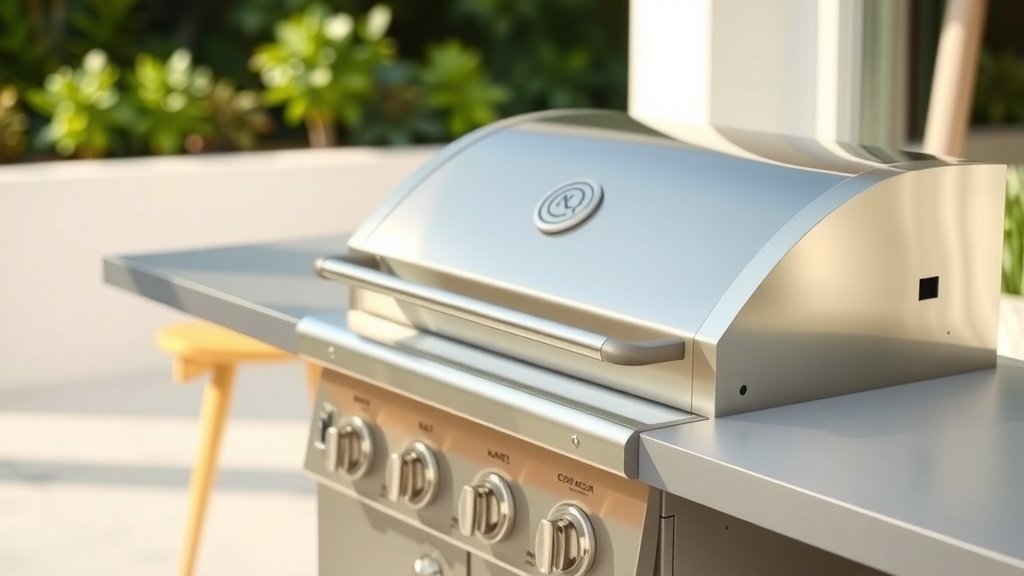
A gas grill works by delivering fuel (propane or natural gas) through a regulator and manifold to burner tubes, where it mixes with air and ignites to create heat for cooking.
This controlled combustion ensures a consistent cooking temperature, making grilling efficient and enjoyable for you.
- Fuel Delivery: Gas travels from a tank or line through a regulator and hose.
- Gas Distribution: It enters a manifold, then goes to individual burner valves.
- Burner Activation: Turning a knob opens a valve, sending gas to the burner.
- Ignition Spark: An igniter creates a spark, lighting the gas-air mixture.
- Heat Generation: The burning gas heats cooking grates, vaporizing drippings for flavor.
- Maintenance: Regular cleaning keeps your grill working safely and efficiently.
How Does Gas Grill Work?
A gas grill operates by taking a steady supply of gas, mixing it with oxygen, and then igniting that mixture. This controlled flame heats the grill grates or flavorizer bars, which in turn cook your food evenly.
The Gas Path: From Tank to Burner
Ever wondered how your propane tank transforms into sizzling steaks? It’s a clever system! First, your grill needs a gas source. This is usually a propane tank or a natural gas line hooked up to your home.
Propane or Natural Gas? Your Fuel Options
You generally have two main choices for fuel. Propane is portable, coming in refillable tanks, great for moving your grill around. Natural gas connects directly to your home’s supply, offering a constant, unlimited fuel source (American Gas Association).
| Feature | Propane Gas | Natural Gas |
|---|---|---|
| Source | Portable tanks | Home gas line |
| Cost | Refill/exchange tanks | Utility bill |
| Portability | High | Low (fixed location) |
| BTUs | Higher energy density | Lower energy density |
Regulating the Flow of Gas
Once you connect your tank or line, the gas flows through a hose. But hold on! Gas pressure from a tank is very high. That’s where the regulator steps in. It lowers the gas pressure to a safe, usable level for your grill (Consumer Product Safety Commission).
Directing Gas to Burners
After the regulator, the gas enters a manifold. Think of this as a central pipe that splits off, sending gas to each burner valve. When you turn a knob on your grill, you’re operating a burner valve, controlling the gas flow.
Igniting the Heat
You’ve got gas flowing, now you need fire! This step is often overlooked but it’s vital. Most modern gas grills use an electronic igniter. No more fiddling with matches, right?
The Spark and the Flame
Pushing a button or turning a knob activates the igniter. This creates a small electric spark right next to the burner. When the spark meets the gas-air mixture, poof! You have a flame. Many experts say this system offers a reliable start.
The Burners and Heat Distribution
The burners are the core of your grill. They’re typically long, perforated tubes. Gas mixes with air inside these tubes before exiting through small holes. This precise mix is vital for efficient combustion.
Flavorizer Bars for Even Cooking
Modern grills often feature metal “flavorizer bars” above the burners. These serve a couple of important roles. First, they help to spread the heat, reducing hot spots. Second, when fats and juices drip onto these hot bars, they vaporize, creating that signature barbecue flavor.
How Food Cooks: Radiant and Convective Heat
Once the grates are hot, your food cooks through a combination of radiant and convective heat. Radiant heat comes directly from the hot grates and flames. Convective heat is the hot air circulating inside the closed grill lid.
Why Close the Lid?
You might wonder, “Why keep the lid down?” Many chefs and grill masters recommend keeping the lid closed as much as possible. This traps the heat, allowing the convective heat to cook food more uniformly and efficiently, much like an oven (Culinary Institute of America).
Keeping Your Grill Running Smoothly
To keep your grill working well for years, some regular care is a must. A little effort now prevents bigger headaches later. Don’t let grime build up and affect your next cookout!
Essential Maintenance Checklist
- Check gas hose for cracks before each use.
- Clean cooking grates after every use.
- Empty and clean drip tray regularly.
- Inspect burner ports for blockages (spiders love them!).
- Clean flavorizer bars of any hardened grease.
- Tighten any loose hardware.
Safe Grilling Practices
Grilling is fun, but safety should always be your top concern. We found that most grill-related incidents are preventable with basic precautions.
Leak Testing Your Grill
Periodically, perform a leak test. Mix some dish soap and water, then brush it over the gas hose and connections. If you see bubbles forming when the gas is on (but the grill is off!), you have a leak. Turn off the gas immediately and fix the issue (National Fire Protection Association).
Common Grill Issues and Solutions
Sometimes, your grill might not light up or heat correctly. Don’t worry, many problems have simple fixes. We found that checking a few key areas solves most issues.
When Your Grill Won’t Light
First, check your gas supply. Is the tank full? Is the valve fully open? Next, look at your igniter. Is it sparking? If not, the battery might be dead or the igniter tip might be dirty. Sometimes, a burner port gets clogged, preventing gas flow (Weber Grill Guides).
Dealing with Uneven Heat
If one side is hotter than the other, your burners might be dirty or corroded. Clean the burner ports carefully. Also, check your flavorizer bars; they might be out of place or worn out. Sometimes, a clogged regulator can cause uneven pressure, but this is less common.
Conclusion
Understanding how your gas grill works demystifies the cooking process and helps you get the best results every time. From the simple flow of gas to the perfect sizzle, each component plays an essential role. By caring for your grill and understanding its basic operations, you’re set for countless delicious meals. Keep grilling, keep enjoying!
Is a gas grill easy to use for beginners?
Yes, gas grills are often considered very beginner-friendly. They light quickly, offer precise temperature control with knobs, and clean up relatively easily compared to charcoal grills. Many find them less intimidating to start grilling with.
How often should I clean my gas grill burners?
You should aim to inspect and clean your gas grill burners at least once or twice a grilling season, especially if you grill frequently. Regular inspection helps prevent clogs and ensures even heat distribution, as many experts suggest (Barbecue Industry Association).
Can I convert my propane grill to natural gas?
Yes, it’s often possible to convert a propane grill to natural gas, but it requires a conversion kit specifically designed for your grill model. This process usually involves changing the gas orifices and the regulator. We found it’s best to have a qualified professional handle this conversion for safety.
Why does my gas grill’s flame turn yellow or orange?
A healthy gas grill flame should be mostly blue with a yellow tip. If your flame is largely yellow or orange, it usually indicates improper gas-to-air mixture. This can happen if burner ports are clogged, the air shutters are misadjusted, or there’s a problem with the regulator.
What’s the best way to preheat a gas grill?
To preheat your gas grill effectively, turn all burners to high, close the lid, and let it heat for 10-15 minutes. This gets the grates hot enough to sear food and helps burn off any leftover food particles, preparing your cooking surface properly.
