
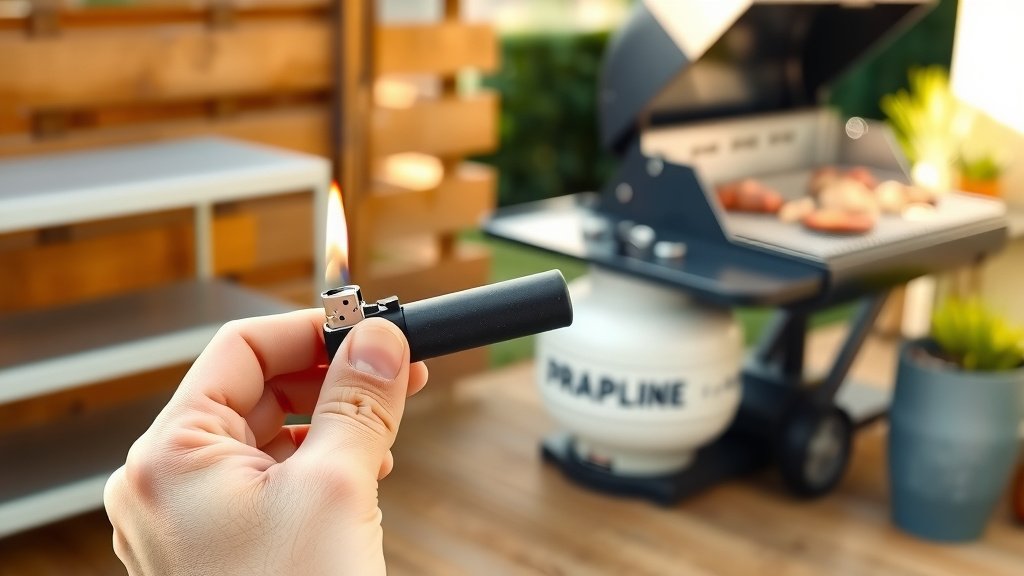
You can light a propane grill with a lighter by turning on the gas briefly, holding a long lighter near a burner port, and then turning the burner knob to high.
Always prioritize safety, ensuring your face and clothing are clear of the grill as you ignite the propane gas manually.
- If your grill’s igniter fails, a long-stem lighter is your go-to solution.
- Always ensure the grill lid is open before you try to light it manually.
- First, turn on the propane tank, then select one burner and turn its knob to high.
- Position the long lighter near the burner’s gas ports and ignite it carefully.
- Safety is key: stand back a bit and use a long lighter to protect your hands.
How To Light Propane Grill With Lighter?
To manually light your propane grill, open the lid, turn on your propane tank, and then turn one burner to high.
Use a long-stem lighter to ignite the burner ports, keeping your hands safe from any potential flare-up.
Picture this: you have friends over, the food is ready, and your propane grill’s igniter decides to take a vacation. Frustrating, right?
Don’t worry, a simple lighter can save your barbecue. It’s a skill every grill master should have in their toolkit.
Why Would You Need a Lighter?
Sometimes, the built-in igniter on your grill just stops working. Maybe it’s wet, corroded, or just needs a new battery.
This is where knowing how to light a propane grill with a lighter becomes a really handy trick. It means the party doesn’t have to stop!
Many experts say that having a backup lighting method is smart for any grill owner (National Fire Protection Association).
Essential Safety Steps Before You Start
Before you even think about lighting your grill, safety must come first. You’re dealing with propane, which needs respect.
Just like checking your car’s tires before a trip, a quick safety check for your grill is non-negotiable.
Check for Gas Leaks
Before you start, do a quick leak check. You can mix some dish soap and water into a spray bottle.
Spray this mixture on the tank connections and gas lines. If you see bubbles, you have a leak. Tighten connections or replace faulty parts immediately.
Research confirms that even small gas leaks can pose a significant risk (U.S. Consumer Product Safety Commission).
Always Keep the Lid Open
This is perhaps the most important rule. Never try to light a propane grill with the lid closed.
Propane can build up inside, creating a dangerous explosion risk. Always keep the lid wide open before turning on any gas.
Gathering Your Manual Lighting Tools
What do you need? It’s pretty straightforward, really.
You’ll want a long-stem lighter, like a utility lighter or a fireplace lighter. This keeps your hands a safe distance from the burner.
A short match or small lighter is too risky and can lead to burns. Safety is your main focus here.
Step-by-Step: Lighting Your Grill Manually
Ready to get that grill going? Let’s walk through the steps together.
Think of it like following a recipe; each step is important for a successful outcome.
Step 1: Connect the Propane Tank
First, make sure your propane tank is securely connected to your grill. Then, slowly open the valve on the tank completely.
You should hear a slight hiss of gas for a second, which is normal.
Step 2: Open the Grill Lid
As we talked about, open the grill lid all the way. Seriously, don’t skip this part.
This allows any gas to escape safely into the air and prevents dangerous gas build-up.
Step 3: Turn on Gas to One Burner
Choose one burner, usually one that’s easy to reach. Turn its control knob to the “High” setting.
Only turn on one burner for now. This limits the amount of gas released and makes it easier to control.
Step 4: Ignite with Your Lighter
Now, grab your long-stem lighter. Hold the flame near the gas ports of the burner you just turned on.
Ignite the lighter and carefully move the flame towards the burner. It should light up within a few seconds with a “whoosh” sound.
If it doesn’t light in about five seconds, turn off the burner, wait a few minutes for the gas to dissipate, and try again.
Here’s a quick overview of manual versus automatic ignition:
| Feature | Built-in Igniter | Manual Lighter |
|---|---|---|
| Ease of Use | Push a button, lights instantly | Requires more direct action |
| Reliability | Can fail due to moisture or battery | Always works if there’s gas |
| Safety Distance | Hands away from flame | Needs careful flame placement |
| Cost | Included with grill, needs battery | Small one-time purchase |
Step 5: Close the Tank After Use
Once you are finished grilling, remember to turn off all the burner knobs first.
Then, always close the valve on your propane tank. This prevents leaks and conserves gas.
What If It Doesn’t Light? Troubleshooting Tips
Sometimes, even with a lighter, things don’t go as planned. Don’t throw in the towel yet.
There are a few simple checks you can do to get things working.
Inspect the Burner Ports
Are the burner ports clogged? Sometimes food debris or spider webs can block the gas flow.
You can use a small wire brush or a paperclip to carefully clean out any obstructions when the grill is cold and off.
Check Your Gas Supply
Is your propane tank actually full? Sometimes the simplest answer is the correct one.
Also, ensure the tank valve is fully open. A partially open valve can restrict gas flow, preventing ignition.
When Not to Use a Lighter
There are definitely times when using a lighter is a bad idea. For example, if you smell a strong gas odor even before opening the tank valve.
Also, if you’ve already tried to light the grill several times with no success and gas has been flowing for a while, stop and wait. Let the gas clear completely.
Here’s a quick safety checklist for your peace of mind:
- Is the grill lid completely open?
- Are all grill connections secure and leak-free?
- Do you have a long-stem lighter ready?
- Are children or pets at a safe distance?
- Is your clothing clear of the grill area?
Conclusion
Learning how to light a propane grill with a lighter is a truly practical skill for any backyard chef. It ensures your grilling plans never get derailed by a faulty igniter.
By following these steps carefully and always putting safety first, you can confidently light your grill and get back to what matters: enjoying delicious food with friends and family. Happy grilling!
Can I use a regular match to light a propane grill?
Using a regular match is generally not recommended because it requires putting your hand too close to the burner, increasing the risk of burns. A long-stem utility lighter is much safer for manual ignition.
What should I do if my grill lights but then goes out immediately?
If your grill lights and then quickly extinguishes, it often indicates a “bypass mode” in your propane regulator. Try turning off all burners and the tank valve, disconnecting the regulator, waiting a few minutes, then reconnecting and slowly opening the tank valve before trying to light it again.
How often should I check for gas leaks on my propane grill?
It’s a good practice to check for gas leaks at the beginning of each grilling season or any time you replace your propane tank. Use the soap and water solution method to identify any bubbles, which signal a leak.
Is it safe to leave the propane tank valve open between grilling sessions?
No, it’s not safe. You should always turn off the propane tank valve after each grilling session. This prevents potential leaks, conserves gas, and ensures safety when the grill is not in use.
What are common reasons for a grill’s igniter to fail?
Common reasons for igniter failure include dead batteries (if applicable), moisture getting into the igniter mechanism, corrosion on the igniter electrodes, or simply a loose wire connection. Regularly cleaning and inspecting your grill can help prevent these issues.
