
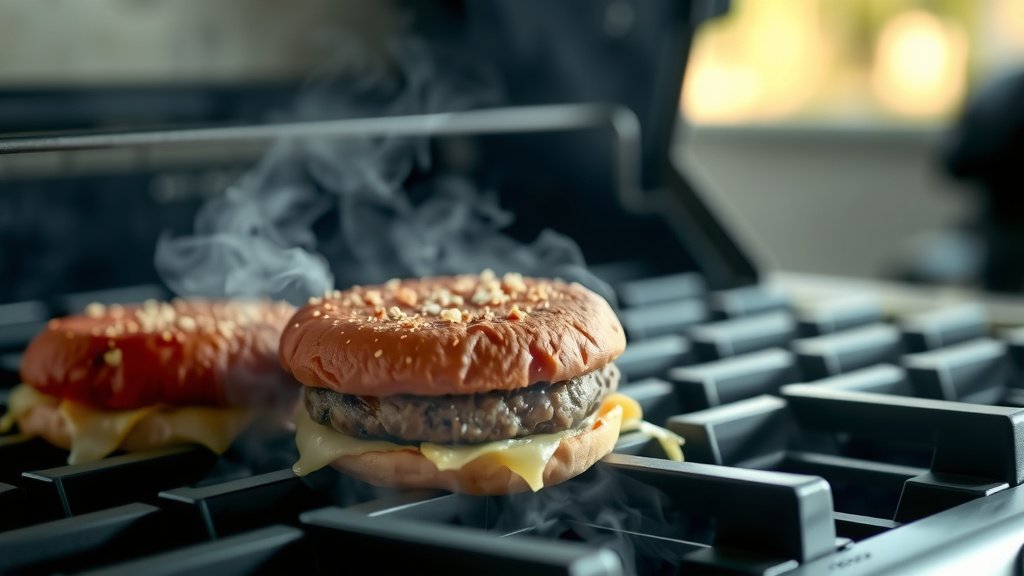
To grill hamburgers on a gas grill, preheat your grill to medium-high (400-450°F), sear the patties for 2-3 minutes per side over direct heat, then move to indirect heat if needed to finish cooking to your desired doneness.
Always ensure your burgers reach an internal temperature of 160°F for food safety when grilling hamburgers, using a meat thermometer for accuracy.
Ready for perfectly grilled burgers? Here’s the quick rundown:
- Preheat your gas grill to medium-high heat for a great sear.
- Form consistent patties, about 3/4-inch thick, with a thumbprint in the center.
- Season generously right before grilling for best flavor.
- Cook 3-5 minutes per side, flipping only once, until internal temperature reaches 160°F.
- Add cheese in the last minute and let your burgers rest briefly after cooking.
How Do You Grill Hamburgers On A Gas Grill?
You grill hamburgers on a gas grill by first getting the grates hot, then searing patties over direct heat before moving them to a cooler zone to cook through evenly.
Achieving a juicy burger involves careful temperature control and knowing when to flip.
Prepping Your Grill for Success
Before you even think about patties, get your grill ready. Clean grates prevent sticking and give you those beautiful grill marks.
We found that using a wire brush on hot grates is the most effective method for cleaning.
Igniting Your Gas Grill
Open the lid, turn on your gas supply, then ignite your burners. Start with one burner, then light the others.
Keep the lid open during ignition to prevent gas buildup, which is a key safety tip.
Preheating for Optimal Sear
Close the lid and allow your grill to preheat. For burgers, aiming for a medium-high temperature, around 400-450°F, works best.
This usually takes 10-15 minutes. A hot grill is essential for a great sear and helps keep juices inside.
Choosing the Best Ground Beef for Your Burgers
The right ground beef makes all the difference. Many experts say an 80/20 lean-to-fat ratio is ideal for juicy, flavorful burgers.
This ratio provides enough fat to keep the burger moist without making it greasy. Less fat can result in dry burgers.
Forming Perfect Patties: Tips and Tricks
Don’t overwork the meat when forming patties; this can make them tough. Gently shape them into 3/4-inch thick disks.
Make them slightly wider than your buns, as they shrink during cooking. Press a small dimple in the center of each patty; this prevents bulging.
Seasoning Your Burgers: A Flavor Foundation
Keep seasoning simple. A generous sprinkle of salt and freshly ground black pepper works wonders.
Season your patties just before they hit the grill. Salting too early can draw out moisture, making them dry.
Grill Temperature: The Hot Zone
Direct medium-high heat is your friend for burgers. This allows for a great crust to form quickly.
If your grill has multiple zones, you can set one burner to medium and another to low, creating a two-zone cooking area.
Grilling Time: How Long Per Side?
The cooking time varies based on thickness and desired doneness. For a 3/4-inch patty cooked to medium, you’re looking at about 3-5 minutes per side.
Rare will be less time, while well-done will be more. Always check internal temperature for accuracy.
The Flip Rule: When to Turn Your Burgers
Resist the urge to flip constantly. Flipping too often prevents a good crust from forming and can dry out your burger.
Flip your burger only once. Wait until you see a nice sear and juices bubbling on top before turning.
Checking for Doneness: No More Guesswork
The most accurate way to check for doneness is with an instant-read meat thermometer. Insert it horizontally into the side of the patty.
For safe consumption, the USDA recommends an internal temperature of 160°F for ground beef.
| Doneness Level | Internal Temperature | Appearance |
|---|---|---|
| Rare | 125-130°F | Cool red center |
| Medium-Rare | 130-135°F | Warm red center |
| Medium | 135-140°F | Warm pink center |
| Medium-Well | 140-145°F | Slightly pink center |
| Well-Done | 150-160°F | No pink, gray throughout |
Adding Cheese: The Ultimate Melt
If you love cheeseburgers, add your slice in the last minute or two of cooking. This gives it just enough time to melt perfectly.
Close the grill lid for about 30 seconds after adding the cheese to trap heat and speed up the melt.
Resting Your Burgers: A Key Step
Just like with steaks, letting your burgers rest after grilling is important. Remove them from the grill and let them sit for 2-3 minutes.
This allows the juices to redistribute throughout the patty, resulting in a more moist and flavorful burger.
Common Burger Grilling Mistakes to Avoid
- Pressing the patties with a spatula: This pushes out all the delicious juices.
- Grilling cold patties: Let them sit at room temperature for 15 minutes before grilling for even cooking.
- Overcrowding the grill: Give each burger space for proper airflow and searing.
Quick Checklist for Grilling Burgers
- Clean your grill grates.
- Preheat grill to 400-450°F.
- Form patties with a thumbprint.
- Season just before grilling.
- Flip once, only when seared.
- Use a meat thermometer for safety.
Conclusion
Grilling a truly great hamburger on a gas grill is all about understanding the basics and executing them with care. From the initial patty prep to the final resting period, each step plays a role in creating that perfect, juicy burger.
Remember, practice makes perfect. So fire up your grill, follow these tips, and enjoy the delicious rewards of your efforts!
How do you prevent burgers from sticking to the grill?
To prevent burgers from sticking, ensure your grill grates are clean and hot before placing the patties. You can also lightly brush the patties with a small amount of high-heat oil just before grilling.
Should I oil my burger patties before grilling?
You can lightly brush your burger patties with oil, especially if you’re using very lean ground beef. This helps prevent sticking and can aid in developing a nice crust. However, it’s not strictly necessary with 80/20 ground beef.
What is the best way to season hamburgers?
The best way to season hamburgers is to keep it simple. A generous amount of salt and freshly ground black pepper applied just before grilling is often all you need. You can also add garlic powder or onion powder for extra flavor.
Can I grill frozen hamburger patties on a gas grill?
While possible, grilling frozen hamburger patties is generally not recommended for best results. They take longer to cook, often dry out, and can cook unevenly. Thawing them first allows for better texture and flavor.
How do you know when a hamburger is done without a thermometer?
Without a thermometer, it’s harder to be precise. You might look for the juices to run clear when poked, or assess firmness (firmer for more done). However, for food safety and optimal taste, a meat thermometer is always the most reliable tool to know when a hamburger is done.
