
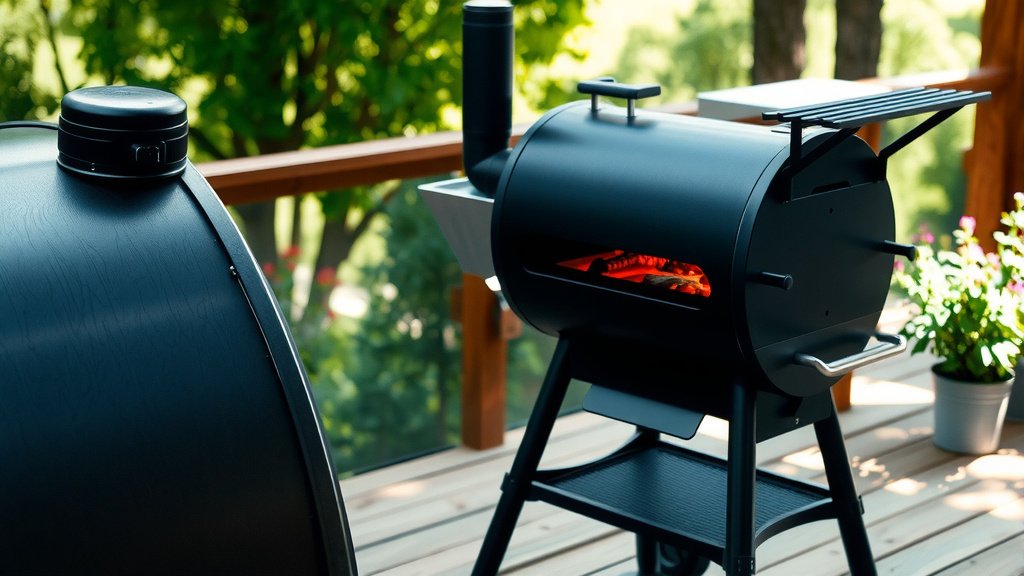
A smoker grill can cost anywhere from $100 for very basic models to over $5,000 for high-end, professional units, with many popular options falling in the $300 to $1500 range. The final price of your smoker grill often depends on its type, size, brand, and the features you desire.
You will find a wide spectrum of prices because smoker grills vary greatly in design, material quality, and smoking capabilities, impacting your overall investment.
- Smoker grill prices typically start around $100 for basic models and can exceed $5,000 for premium units.
- The main types are charcoal, propane, electric, pellet, and ceramic (kamado), each with different average costs.
- Factors like size, material, brand, and smart features significantly affect the price tag.
- You can find a suitable smoker grill for nearly any budget, offering good value at different price points.
- Understanding your needs and how much you want to spend helps you pick the right smoker grill.
How Much Is A Smoker Grill?
You might be surprised by the wide price range when you start looking for a smoker grill. We found that prices truly span a broad spectrum, from budget-friendly options to professional-grade equipment.
Your ideal smoker grill budget will largely depend on your grilling habits, the features you want, and how often you plan to use it.
The Wide Price Range of Smoker Grills
Thinking about how much a smoker grill costs can feel a bit overwhelming at first. It is a bit like buying a car; there are so many options. We’ve broken down the general price tiers to help you get a clearer picture.
Budget-Friendly Smoker Grills (Under $300)
For those just starting or on a tighter budget, many great options exist below $300. These typically include basic charcoal barrel smokers, smaller electric smokers, or entry-level propane models. You get a functional smoker grill that does the job well.
These models are perfect for occasional use or for learning the art of smoking. You might not find all the fancy bells and whistles, but they are a solid starting point.
Mid-Range Smoker Grills ($300-$1500)
This is where most home enthusiasts find their sweet spot. In this range, you will see a significant jump in quality and features. This category includes popular pellet grills, larger charcoal smokers, and more robust electric or propane units.
Many experts say that this price point offers the best balance of performance, durability, and added conveniences. You often get better temperature control and larger cooking areas here.
Premium Smoker Grills (Over $1500)
If you are serious about smoking or cooking for a crowd, premium smoker grills deliver top-tier performance. This category includes high-end kamado grills, large offset smokers, and sophisticated pellet grills with advanced technology. We found that these units often feature exceptional build quality and precise temperature management.
You are paying for superior materials, innovative features, and often a larger capacity. These are built to last and provide consistent, professional-level results.
What Makes Smoker Grills So Different in Price?
Just like how a coffee maker can range from a simple drip machine to an espresso behemoth, smoker grills have many factors that push their price up or down. Understanding these helps you decide what is worth your money.
Smoker Grill Type Matters
The type of fuel and design often sets the baseline for a smoker grill’s cost. Each kind has its own set of advantages and typical price points. Let’s look at the main ones.
Charcoal Smoker Grill Costs
Charcoal smokers are often the most affordable entry point. You can find basic bullet or barrel smokers for under $100. More advanced or larger charcoal units, like kettle grills with smoking attachments, might reach $300-$600.
They offer that classic smoky flavor but require more hands-on temperature management. Many people love this traditional approach.
Propane Smoker Grill Costs
Propane smokers generally fall into the $150-$500 range. They are known for their ease of use and consistent heat. You simply hook up a propane tank, and you are ready to go.
They are a good middle-ground option for those who want simplicity without breaking the bank. Research often connects their convenience with higher user satisfaction (Consumer Reports).
Electric Smoker Grill Costs
Electric smokers are incredibly easy to operate, often priced between $100 and $700. Just plug them in, set the temperature, and add wood chips. They are ideal for beginners or those who want a “set it and forget it” experience.
Many experts say these are fantastic for city dwellers or those without much outdoor space. They deliver a reliable smoke profile.
Pellet Smoker Grill Costs
Pellet grills are quite popular and range from $300 to over $2,000. These machines use wood pellets as fuel, offering a combination of convenience and authentic wood-fired flavor. They often come with digital controls and Wi-Fi connectivity.
We found that pellet grills are highly valued for their precise temperature control and versatility. You can smoke, grill, and even bake on many models.
Kamado Grill Smoker Costs
Kamado grills are usually the most expensive, starting around $400 and easily exceeding $2,500. These ceramic grills are highly efficient and versatile. They excel at smoking, grilling, searing, and baking due to their excellent heat retention.
Many experts point to kamado grills for their durability and ability to reach very high or very low temperatures consistently. They are a significant investment but offer incredible performance (Grill Magazine).
| Smoker Grill Type | Typical Price Range | Key Feature |
|---|---|---|
| Charcoal | $100 – $600 | Classic smoky flavor, hands-on |
| Propane | $150 – $500 | Easy to use, consistent heat |
| Electric | $100 – $700 | “Set it and forget it,” very user-friendly |
| Pellet | $300 – $2,000+ | Convenience, precise temp control, wood flavor |
| Kamado | $400 – $2,500+ | Versatile, excellent heat retention, durable |
Size and Capacity Influence Price
It makes sense, right? A bigger smoker grill generally costs more. If you are feeding a small family, a compact model will be enough. But if you are smoking a whole hog or multiple briskets, you need a larger cooking surface.
Consider the total cooking area, often measured in square inches. More space means more materials and a higher price. Think about how much food you usually cook at once.
Build Quality and Materials
The materials used in construction play a huge role in the price and longevity of a smoker grill. Stainless steel, cast iron, and thick-gauge steel usually cost more than thinner metals. Ceramic construction, like in kamado grills, is also a premium material.
Better materials usually mean better heat retention, more even cooking, and a smoker grill that will last for many years. We found that investing in quality often saves you money in the long run.
Brand Recognition and Features
Just like with any product, popular brands might carry a slightly higher price tag. This can reflect their reputation for reliability, customer service, or innovative design. You are often paying for peace of mind and proven performance.
Modern smoker grills also come with a host of features: Wi-Fi connectivity, app control, integrated meat probes, automatic pellet feeding systems, and advanced insulation. Each added feature can contribute to a higher cost.
Finding Your Ideal Smoker Grill Budget
So, how do you decide how much to spend on your smoker grill? It is all about aligning your needs with what is available. We found that asking yourself a few key questions can really help narrow down the options.
Checklist: What to Consider Before Buying
- How often will you use the smoker grill? (Daily, weekly, monthly?)
- What kind of food do you plan to smoke or grill? (Small cuts, whole briskets, multiple items?)
- How much cooking space do you need? (For a family of 2-4, or large gatherings?)
- What is your desired level of convenience? (Hands-on, or “set it and forget it”?)
- How much maintenance are you willing to do? (Charcoal requires more cleaning than electric.)
- What is your priority: flavor, ease of use, versatility, or durability?
Once you answer these, you will have a much clearer idea of what type of smoker grill and price point will make you happy.
Conclusion
Figuring out how much a smoker grill costs is not a simple answer, but now you have a better understanding of the factors involved. From economical charcoal units to luxurious kamado grills, there is a perfect match for every budget and grilling style.
We encourage you to think about your specific needs, how you plan to use it, and what features truly matter to you. By considering these points, you can invest in a smoker grill that brings you years of delicious, smoky goodness without any regrets.
What is the cheapest type of smoker grill?
The cheapest type of smoker grill is typically a basic charcoal smoker, often found for under $100. These are simple to use and provide an authentic smoky flavor, making them a great starting point for beginners.
Do more expensive smoker grills really perform better?
Generally, yes. More expensive smoker grills often feature better build quality, thicker materials, more precise temperature control, and advanced features like Wi-Fi connectivity. These attributes usually lead to more consistent results and greater durability over time.
Can I use a regular grill as a smoker?
You can often convert a regular grill into a smoker with some modifications, like using a smoker box for wood chips and setting up a two-zone cooking system. While it can produce smoky flavor, it typically will not offer the same precise temperature control or consistent low temperatures as a dedicated smoker grill.
What is the average lifespan of a smoker grill?
The average lifespan of a smoker grill varies greatly by type and build quality. A budget-friendly charcoal or electric smoker might last 3-5 years, while a high-end pellet grill or a well-maintained kamado grill can last 10-20 years or even longer. Proper care and maintenance significantly extend its life.
Is it worth buying a smoker grill with smart features?
Whether smart features are worth it depends on your preference for convenience. Features like Wi-Fi control and integrated meat probes allow you to monitor and adjust your cook remotely, which many users find incredibly helpful. If you value hands-off operation and precision, these features can be a great investment.
