
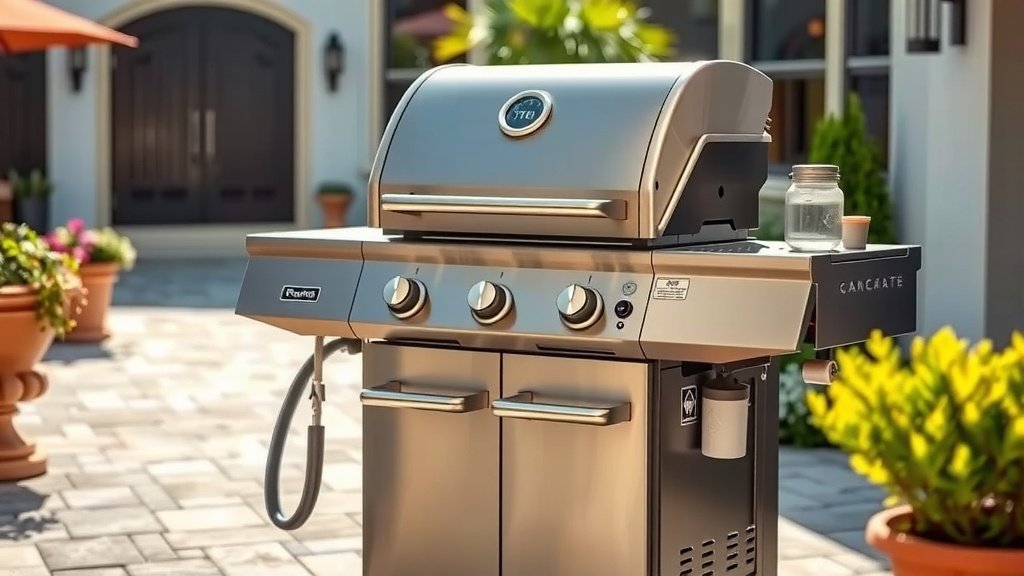
A good BTU for a gas grill generally ranges between 75 and 100 BTUs per square inch of primary cooking surface, offering a strong balance of heat output and fuel efficiency for most grilling needs.
To determine what is a good BTU for a gas grill, you should primarily look at the grill’s total cooking area rather than just the raw BTU number, as this indicates how well it can distribute heat.
- A grill’s BTU measures its maximum heat output, but it is not the only factor for a great grilling experience.
- The ideal BTU for your gas grill depends on its size and how you plan to use it for cooking.
- Aim for 75-100 BTUs per square inch of cooking space for effective and efficient heating.
- High BTU alone does not guarantee superior performance; heat retention and even distribution are also important.
- Always consider the grill’s construction, grate material, and burner design alongside its BTU rating.
What Is A Good BTU For A Gas Grill?
A good BTU for a gas grill balances power with efficiency, allowing you to achieve high searing temperatures and consistent low heat. It’s about having enough heat to cook what you want, when you want it.
Understanding BTU: What It Means
BTU stands for British Thermal Unit, and it measures the amount of heat energy a grill can produce. Think of it like horsepower in a car; a higher number often means more potential power. For grills, it shows the maximum heat output from all burners combined over one hour.
BTU vs. Grill Size: A Key Relationship
Simply seeing a high BTU number on a large grill isn’t the full story. A big grill needs more BTUs to heat its larger surface. We found that the best way to judge is by looking at BTUs per square inch of the main cooking area. This gives you a better sense of true heating power.
Factors Affecting Your Ideal BTU
Your perfect BTU rating isn’t a one-size-fits-all answer. Several things play a part in what will work best for you. Let’s explore what truly makes a difference when choosing your next grill.
Cooking Style Matters
Do you love a good steak with perfect sear marks, or do you mostly grill chicken and veggies? Searing requires higher, more intense heat. Low-and-slow cooking, like smoking with a gas grill, needs consistent, lower heat. Your preferred cooking style really guides your BTU needs.
Grill Grate Material
The material of your grill grates greatly impacts heat retention. Heavy cast iron grates, for example, hold heat exceptionally well, meaning they need less constant BTU output to stay hot. Stainless steel grates heat up faster but may not retain heat as long.
Climate and Environment
Live in a windy area or grill often in cooler temperatures? Your grill will need more power to fight against the elements. A higher BTU might be more helpful if you frequently grill in colder or breezier conditions to maintain desired cooking temperatures.
Is More BTU Always Better?
Not necessarily. While a higher BTU can mean faster preheating and hotter searing, it also often means more fuel consumption. An overly high BTU for a small grill can lead to hot spots and uneven cooking. It’s about balance, not just raw power.
The “Sweet Spot” For BTU Ratings
Many experts say that finding the right BTU involves matching it to your grill’s size. Aim for effective heat delivery across your entire cooking surface. Here’s a general guide:
Small Grills (200-300 sq. inches)
For smaller grills, suitable for couples or small families, a total BTU between 20,000 and 30,000 is often plenty. This range offers quick heating and efficiency for intimate gatherings.
Medium Grills (400-500 sq. inches)
If you host backyard cookouts for friends, a medium-sized grill is great. We found that a BTU between 30,000 and 50,000 generally works well here. This allows for more versatility in cooking different foods at once.
Large Grills (600+ sq. inches)
For the serious entertainer or large family, large grills demand more power. Look for total BTUs in the 50,000 to 75,000 range or even higher. This ensures consistent heat across a big cooking area (NIH).
Beyond Just BTU: Other Important Features
While BTU is a factor, it’s only one piece of the puzzle. A great grill is a symphony of features working together. You want to consider aspects that support and enhance the heat output.
- Quality Construction: A sturdy lid and firebox help retain heat, making your BTUs more effective.
- Even Heat Distribution: Look for good burner placement and heat tents to spread warmth evenly.
- Grill Grate Type: As mentioned, material like cast iron holds heat for better searing.
- Side Burners/Rotisserie: These extra features add versatility but are separate from main grill BTUs.
Checking For Even Heat Distribution
A grill with even heat distribution prevents some foods from burning while others cook slowly. To check, preheat your grill, then lay slices of white bread across the grates. After a few minutes, you can see the toast pattern. Uniform browning means excellent heat distribution, regardless of super high BTU.
Ignition Systems and Build Quality
A reliable ignition system saves you from frustration. Also, inspect the overall build quality. Thick gauge stainless steel and well-assembled parts suggest a grill that will last longer and perform better. Many experts found these details often speak to a grill’s true quality (Cleveland Clinic).
Making Your BTU Work Harder
You can get the most out of your grill’s BTU by following a few simple steps. This helps ensure you’re always ready for a fantastic cookout. It’s about being smart with your heat, not just having the most.
- Preheat Thoroughly: Always let your grill reach temperature before adding food.
- Keep the Lid Closed: Opening the lid too often loses precious heat, forcing burners to work harder.
- Clean Your Grill: Grease and debris block heat and airflow, reducing efficiency.
- Check for Leaks: Ensure gas lines and connections are secure to prevent heat loss.
- Consider a Windbreak: If grilling in a breezy spot, shield your grill to maintain temperature.
BTU Range by Grill Size (Primary Cooking Area)
This table gives you a general idea of what BTU range works best for different grill sizes. Remember, these are guidelines, and your personal use matters most.
| Grill Size Category | Primary Cooking Area (Square Inches) | Recommended Total BTU Range |
|---|---|---|
| Small | Up to 300 | 20,000 – 30,000 |
| Medium | 301 – 500 | 30,000 – 50,000 |
| Large | 501 – 700 | 50,000 – 75,000 |
| Extra Large | 701+ | 75,000+ |
Conclusion
Choosing a good BTU for a gas grill isn’t about chasing the highest number. It’s about finding the right balance for your grilling style, the grill’s size, and its construction quality. Focus on BTUs per square inch and heat distribution for superior results. When you factor in these elements, you’re not just buying a grill; you’re investing in countless delicious meals and memorable moments. Happy grilling!
How do I calculate BTUs per square inch for my grill?
To calculate BTUs per square inch, divide the grill’s total BTU output by its primary cooking area in square inches. For example, a 40,000 BTU grill with 500 square inches of cooking space has 80 BTUs per square inch.
Does a higher BTU grill preheat faster?
Often, yes, a higher BTU grill can preheat faster, especially if it’s well-designed and has good heat retention. However, other factors like grate material and lid thickness also play a role in how quickly and evenly it reaches temperature.
Can a gas grill have too many BTUs?
Yes, a gas grill can have too many BTUs for its size, leading to excessive fuel consumption, hot spots, and potentially burning food. The goal is efficiency and even heat, not just maximum power.
Are infrared burners considered in the main BTU rating?
Yes, if your grill has infrared burners as part of its main cooking area, their BTU output is typically included in the total BTU rating. Infrared burners provide intense, direct heat for searing and can significantly boost overall cooking performance.
How does external temperature affect a grill’s BTU performance?
External temperature, especially cold or windy conditions, can reduce a grill’s effective BTU performance. In colder weather, the grill needs more energy to maintain its internal temperature, making a slightly higher BTU rating more beneficial to compensate for heat loss.
