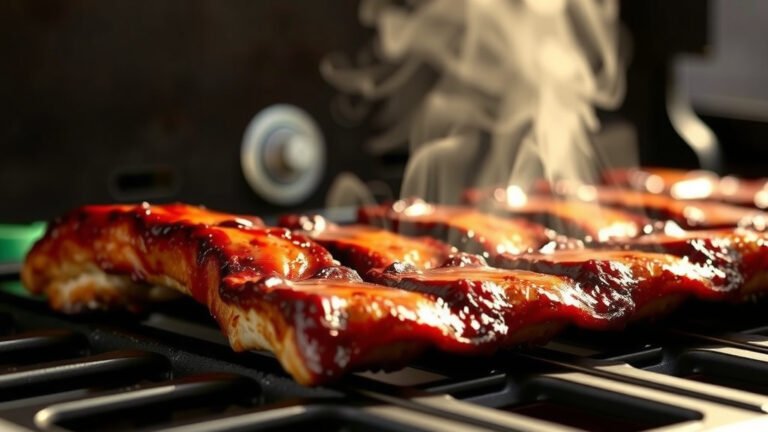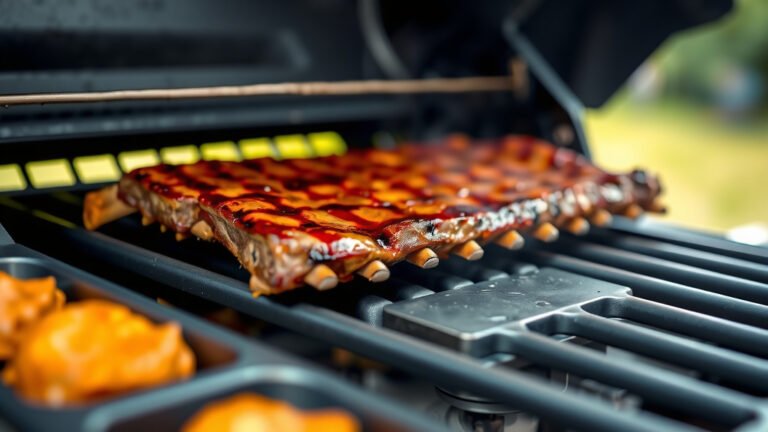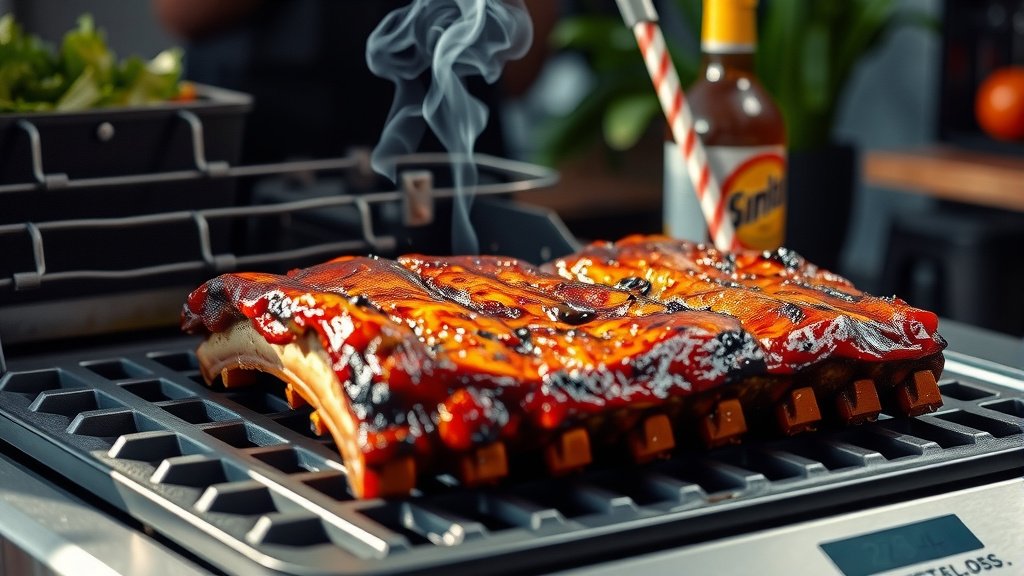
To grill BBQ ribs on a gas grill, use an **indirect heat method** with a consistent low temperature, typically around 225-275°F (107-135°C), for several hours until the ribs are tender.
This “low and slow” approach allows the connective tissues in the ribs to break down, resulting in **fall-off-the-bone tenderness** while preventing them from drying out.
Here’s a quick overview of grilling BBQ ribs on a gas grill:
- Achieve tender ribs by setting up your gas grill for **indirect heat**.
- Maintain a consistent low temperature between **225-275°F** for several hours.
- Always remove the **tough membrane** from the back of the ribs first.
- Use a flavorful rub and apply your favorite BBQ sauce during the final stage for **perfect caramelization**.
- Check for doneness using the **bend test** for truly juicy results.
How To Grill BBQ Ribs On Gas Grill?
Grilling BBQ ribs on a gas grill requires mastering **temperature control** and using indirect heat for a slow, gentle cook.
You will achieve incredibly tender and flavorful ribs by following a few simple, yet **important steps** for a perfect backyard feast.
Why Choose Your Gas Grill for Ribs?
Your gas grill offers **unbeatable convenience** and precise temperature control, making it ideal for ribs.
Unlike charcoal, you can easily maintain a steady, low heat for hours, ensuring a **consistent cooking environment** (USDA).
Picking the Perfect Ribs
Start with quality ribs, either **baby back or spare ribs**, depending on your preference.
Look for racks with a good meat-to-bone ratio and minimal excess fat; **St. Louis style spare ribs** are often a popular choice for their uniform shape.
Essential Prep: Removing the Membrane
This step is non-negotiable for **tender, bite-through ribs** on your gas grill.
The thin, silvery membrane on the bone side of the ribs becomes tough and chewy when cooked, so **peel it off** with a paper towel for grip.
Crafting Your Rub
A good dry rub adds a **layer of flavor** that penetrates the meat during the long cook.
Experiment with sweet, savory, or spicy blends; just be mindful of high-sugar rubs, as they can **burn at higher temperatures**.
Setting Up Your Gas Grill for Success
For ribs, you need a **two-zone setup** on your gas grill.
Light one or two burners on one side to medium-low heat, leaving the other burners off; this creates an **indirect cooking zone**.
Indirect Heat is Your Friend
Placing the ribs over the unlit burners allows them to cook slowly and evenly, without direct flame exposure that would **char the surface too quickly**.
Close the lid and let the internal grill temperature stabilize around **225-275°F (107-135°C)**, which is the sweet spot for tenderness.
| Phase | Temperature | Duration (Approx.) | Goal |
|---|---|---|---|
| Phase 1: Smoke/Cook | 225-275°F | 3 hours | Develop bark, absorb smoke |
| Phase 2: Wrap | 225-275°F | 2 hours | Tenderize, retain moisture |
| Phase 3: Unwrapped/Sauced | 225-275°F | 1 hour | Caramelize sauce, firm bark |
The 3-2-1 Method for Gas Grills
Many pitmasters swear by the **”3-2-1″ method** for spare ribs, though a “2-2-1” works well for baby backs.
This technique breaks down the cooking into three distinct phases to ensure **maximum tenderness and flavor**.
Phase 1: Smoke/Cook (3 Hours)
Place your seasoned ribs, bone-side down, on the **indirect heat side** of your grill.
Maintain that steady 225-275°F temperature; this phase builds flavor and starts to form a **beautiful outer “bark”**.
Phase 2: Wrap (2 Hours)
After three hours, wrap each rack tightly in foil, perhaps with a splash of apple juice or cider for **extra moisture and steam**.
Return the wrapped ribs to the indirect heat; this steaming process helps them **become incredibly tender**.
Phase 3: Unwrapped & Sauced (1 Hour)
Unwrap the ribs, then brush them generously with your **favorite BBQ sauce**.
Place them back on the indirect heat for the final hour, allowing the sauce to **caramelize and set**; watch for burning, especially with sugary sauces.
Monitoring Doneness: The Bend Test
How do you know when they’re ready? A reliable method is the **”bend test.”**
Pick up a rack of ribs with tongs in the middle; if the rack bends significantly and the meat almost wants to **tear apart**, they are done.
Resting Your Ribs
Just like any cooked meat, ribs benefit greatly from a **short resting period**.
Tent them loosely with foil for 10-15 minutes after removing them from the grill; this allows the **juices to redistribute** for a moister result (USDA).
Common Rib Grilling Mistakes to Avoid
Don’t rush the process; ribs need time, so **avoid high heat** that will dry them out.
Also, resist the urge to constantly open the grill lid, as this **loses valuable heat** and extends cooking time.
Rib Grilling Checklist
Before you fire up the grill, ensure you have these essentials:
- Quality Ribs: Fresh and well-marbled.
- Sharp Knife: For trimming any excess fat.
- Paper Towels: Important for membrane removal.
- Your Favorite Rub: Pre-mixed or homemade.
- Aluminum Foil: Heavy-duty for wrapping.
- BBQ Sauce: Ready for the final phase.
- Grill Thermometer: To monitor internal grill temperature accurately.
Adding Smoke Flavor to Your Gas Grill
Even on a gas grill, you can infuse a lovely smoky flavor into your ribs.
Place a **smoke box filled with wood chips** (like hickory or applewood) or a foil pouch of chips directly over a lit burner for a gentle smoke (Weber Grill Academy).
Conclusion
Mastering **how to grill BBQ ribs on a gas grill** truly transforms your backyard cooking game.
By focusing on proper preparation, consistent low temperatures, and the right timing, you can achieve **restaurant-quality tenderness and flavor** right at home.
Remember, patience is a key ingredient; let the grill do its work, and you’ll be rewarded with **succulent, falling-off-the-bone ribs** everyone will love.
Frequently Asked Questions
How long does it take to grill ribs on a gas grill at 225°F?
Grilling ribs on a gas grill at a consistent 225°F (107°C) can take approximately 5-7 hours for spare ribs and 4-6 hours for baby back ribs, especially when following a method like the 3-2-1 technique. The exact time depends on the rib size and thickness.
Do you flip ribs while grilling on a gas grill?
You generally do not need to flip ribs constantly when grilling them on a gas grill using indirect heat. Once you place them bone-side down on the indirect side, they can stay there for hours, especially if wrapped, ensuring even cooking without direct flame exposure.
Can I pre-cook ribs before putting them on the gas grill?
Yes, you can pre-cook ribs by boiling, baking, or even smoking them partially before finishing on the gas grill. This can help tenderize them faster, but many purists prefer to cook them entirely on the grill or smoker to maximize flavor development and bark formation.
What kind of wood chips are best for smoking ribs on a gas grill?
For ribs, popular wood chip choices often include hickory, apple, cherry, or pecan. Hickory offers a strong, traditional BBQ flavor, while fruitwoods like apple and cherry provide a milder, sweeter smoke that pairs well with pork.
How do I prevent my ribs from drying out on the gas grill?
To prevent ribs from drying out, ensure you cook them with indirect heat at a low temperature (225-275°F), use a moistening agent like apple juice when wrapping them in foil, and avoid overcooking. Monitoring the internal grill temperature is also very important for consistent moisture retention.