
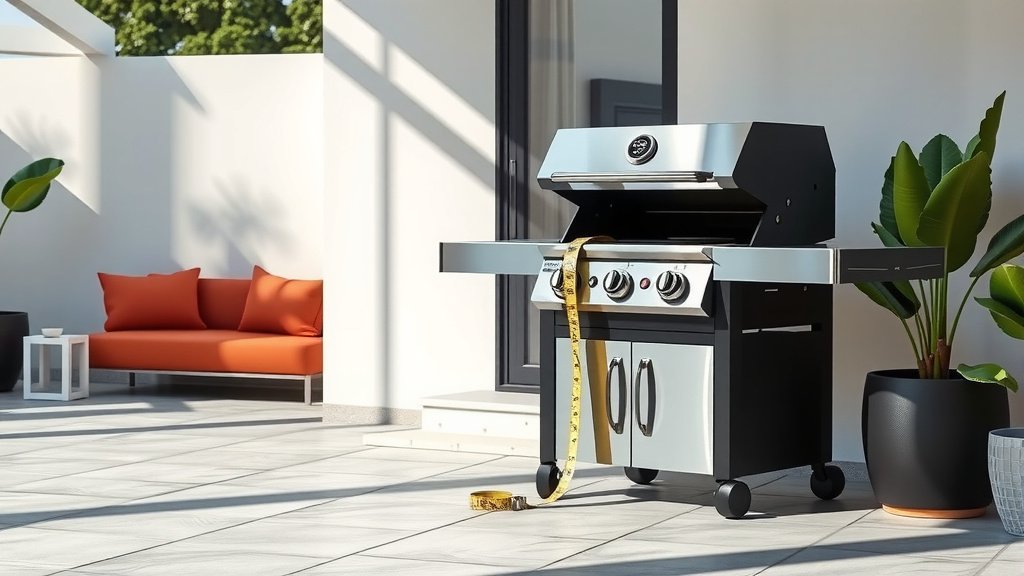
To measure for a BBQ grill cover, you need three main dimensions: width, depth, and height. Use a flexible tape measure to accurately capture these measurements, paying attention to any side shelves or unique grill features.
Always measure the grill itself, not your old cover, to ensure a snug and protective fit for your new BBQ grill cover, extending its lifespan.
- Get your grill’s width, depth, and height using a tape measure.
- Measure the grill’s widest points, including any side tables.
- Allow a few extra inches (1-3) for an easier fit and better airflow.
- Note special features like smokestacks or unique shapes.
- Compare your final measurements to cover product descriptions.
How To Measure For A BBQ Grill Cover?
Measuring for a BBQ grill cover involves taking three critical dimensions: width, depth, and height. This process helps you find a cover that protects your investment from the elements.
Why Does a Proper Grill Cover Fit Matter So Much?
A well-fitting grill cover does more than just look nice; it protects your grill from rain, snow, sun, and dust. A cover that’s too big can flap in the wind, potentially tearing or blowing off entirely. One that’s too small might not protect everything, leaving parts exposed.
We found that a snug, yet not tight, cover helps prevent moisture build-up underneath (Consumer Reports). This prevents rust and corrosion, keeping your grill ready for action.
The Big Three: What You Need to Measure
Think of your grill as a simple box, even if it has some curves. You’ll need to capture its longest, deepest, and tallest points. Let’s break down each measurement.
Getting Your Grill’s Dimensions: Width is Key
The width is often the first thing people consider. It measures your grill from one side to the other. Remember to include any attached side tables, even if they fold down.
If your side tables fold, measure them in their “out” position. This ensures the cover will fit when you need full protection.
Measuring Width: Side to Side
Grab your tape measure. Stand in front of your grill and measure from the outermost edge of one side shelf to the outermost edge of the other side shelf. This gives you the full width. If there are no side shelves, measure the main body of the grill.
Depth: Don’t Forget the Front-to-Back
Depth measures how far your grill extends from the front to the back. This is especially important for grills with prominent lids or control knobs that stick out. Many experts say this measurement is crucial for full coverage (Grilling Magazine).
Measuring Depth: Front to Back
To get the depth, measure from the very front of the grill, perhaps the handle or control panel, to the furthest point at the back. Be sure to account for any protruding parts like a gas tank housing or a rear burner.
Height: From Top to Bottom
The height measurement ensures your cover drapes down to protect the legs and base of your grill. You want it to reach close to the ground, but not drag on it, which could collect dirt or moisture.
Measuring Height: Ground Up
Measure from the highest point of your grill – usually the top of the closed lid – straight down to the ground. If your grill has a smokestack, measure to the very top of that smokestack. This is your total height.
Considering Grill Features: Side Shelves and Smokestacks
Most modern grills have more than just a main body. Those side shelves, side burners, and even smokestacks are part of the overall shape. Ignoring them means your cover won’t fit right.
Think of these as extensions of your grill’s main structure. They need protection too. Research found that covers designed for specific features offer better long-term protection (Outdoor Living Institute).
- Checklist: Important Features to Note
- Folding or fixed side shelves
- Side burners or warming trays
- Integrated rotisserie kits
- Smokestacks or chimney vents
- Propane tank storage (if external)
- Built-in thermometers on the lid
When to Add a Little Extra: The “Slack” Factor
Once you have your exact measurements, consider adding an extra 1-3 inches to each dimension. This isn’t about laziness; it’s about practicality. A little slack makes the cover easier to put on and take off.
Why a Little Extra Room is a Good Idea
Adding a small amount to your measurements helps prevent the cover from being too tight. A tight cover can be hard to stretch over corners and might be more prone to tearing. It also allows for better air circulation, which we found helps reduce condensation (Grill Care Pros).
Using Your Measurements: Finding the Right Cover
With your accurate dimensions in hand, shopping for a cover becomes much easier. Look at the product descriptions for covers and compare them to your recorded width, depth, and height. Remember to compare apples to apples.
| Grill Type | Key Measurement Consideration | Typical Measurement Range (Inches) |
|---|---|---|
| Small Portable Grill | Often just Width x Depth x Height for main body | 18-28W x 15-20D x 15-25H |
| Standard 2-Burner Grill | Include side shelves fully extended | 40-50W x 20-25D x 40-50H |
| Large 4-5 Burner Grill | Account for all accessories, maximum width | 55-70W x 22-30D x 45-60H |
| Offset Smoker | Measure firebox to smoke stack, full length | 50-75W x 20-30D x 40-55H |
What About Universal Grill Covers?
Universal covers can be tempting because of their general sizing. They often come in categories like “small,” “medium,” or “large.” While convenient, they might not offer the best possible fit or protection.
Many universal covers are designed to fit a wide range, meaning they might be baggy in some areas or just barely cover others. For optimal protection, a cover sized close to your grill’s actual dimensions is usually better (BBQ Guys).
Measuring for Oddly Shaped Grills or Smokers
Some grills, like offset smokers or kamado-style cookers, have unique shapes. For these, you still need width, depth, and height, but you might need to identify the absolute widest and tallest points. For a kamado, for example, the height might be to the top of its vent.
For an offset smoker, measure the full length from one end of the firebox to the other end of the smokestack. Then, measure the depth of the main barrel and the height to the top of the stack.
A Quick Checklist Before Buying
- Did you measure the grill itself, not an old cover?
- Are all side shelves and permanent accessories included?
- Did you add 1-3 inches to each measurement?
- Have you considered any unique grill features?
- Are the cover’s dimensions clearly stated in the product description?
Conclusion
Measuring for your BBQ grill cover doesn’t have to be a chore. By carefully taking your grill’s width, depth, and height, and considering any unique features, you’re setting yourself up for success. A well-fitting cover is a small investment that offers huge returns in grill longevity and appearance. So, grab that tape measure, get those numbers, and keep your outdoor cooking companion protected for years of delicious meals.
Can I use my old grill cover to measure for a new one?
No, it’s not a good idea. Your old grill cover might be stretched, faded, or shrunken, giving you inaccurate measurements. Always measure the actual grill itself for the most precise fit.
Should I measure with the grill lid open or closed?
Always measure your grill with the lid closed. This provides the most accurate height and depth dimensions, ensuring the cover will fit properly when your grill is stored away.
What if my grill has folding side shelves?
If your grill has folding side shelves, you should measure its width with the shelves in their extended, “open” position. This guarantees the cover will fit when the shelves are out, providing maximum flexibility.
How much extra room should I allow for the cover?
We recommend adding about 1 to 3 inches to your grill’s exact width, depth, and height measurements. This slight allowance makes the cover easier to put on and take off and promotes better airflow underneath.
Do I need to measure the propane tank?
If your propane tank sits outside the main grill body and contributes to the overall footprint, yes, include it in your depth measurement. However, if it’s stored underneath the grill and doesn’t extend beyond the main frame, it might not factor into the cover’s dimensions.
